
Politics
Why governors should align with Tinubu on LG autonomy

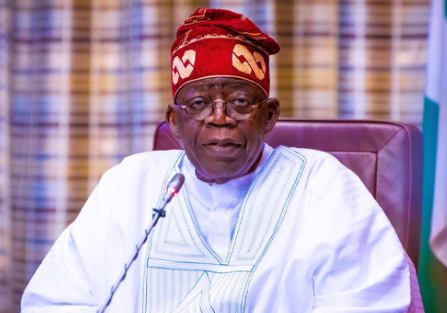
Governors have been acting tongue-in-cheek in their reactions to last Thursday’s verdict of the Supreme Court, which stripped them of their suffocating grip over the money meant for local governments in the country. As a collective, the governors unreservedly endorsed the judgement. The Chairman of the Nigeria Governors’ Forum and Kwara State Governor, AbdulRazaq AbdulRahman, who spoke on behalf of the governors, said the forum welcomed the apex court’s ruling granting financial autonomy to the councils, describing the verdict as a relief from the burden on the governors. Addressing State House correspondents on the matter after a meeting with President Bola Tinubu at the Presidential Villa, Abuja on Friday last week, AbdulRahman was flanked by the Chairman of All Progressives Congress Governors’ Forum, Hope Uzodimma, and Chairman of the Peoples Democratic Party Governors’ Forum, Dr Bala Mohammed, suggesting they were all in agreement with AbdulRahman in his pronouncement.
“Our Attorney-General has applied for the enrolment order, which we will study carefully. But by and large, governors are happy with the devolution of power in respect of local government autonomy. It relieves the burden on governors. Our people really don’t know how much states expend in bailing out local governments, and that’s the issue there,” AbdulRahman said, adding that his government in Kwara State had never tampered with local government funds.
However, it was learnt that the governors were not happy with the decision of the Federal Government to take them to court and are merely playing to the gallery. For instance, a few days after the NGF chairman spoke, Oyo State Governor, Seyi Makinde, who is of the opposition PDP, described the case as a distraction. He questioned the sustainability of local governments receiving allocations from the Federal Government. Speaking with members of the Nigeria Union of Journalists in Ibadan, Oyo State, the governor said: “They said there is a judgment of the Supreme Court on local government autonomy. I think it is just a distraction. We must face the real issue that we have. The issue that we have is that we are not producing enough. We are not productive. Maybe it may be part of the problem, we want to have value for what is being shared but our problem is productivity.”
It may be argued that it is customary in our clime for an opposition governor to toe a different path from that of the President from a different party and this may be correct. However, the opposition of state governors to local council financial autonomy has never been in doubt. It has always been vainly concealed. In a report in The PUNCH newspaper of January 25, 2023, state Houses of Assemblies across Nigeria had rejected nine constitutional amendment bills, including the proposed legislation for financial and administrative autonomy for local government councils. The state Assemblies were believed to have done so at the promptings of their governors who exert considerable influence over legislative processes at the state level. The rejected bills were part of the bills that the National Assembly transmitted to them for concurrence. The National Assembly had in March 2022, voted on 68 bills aimed at further amending the 1999 Constitution. At the end of the exercise, 44 of the bills were approved by both the Senate and the House of Representatives and transmitted to the state Assemblies for concurrence. A simple majority of votes was required in at least two-thirds of state Assemblies (24 out of 36) for the amendments to sail through and the amendments that sailed through would then be sent to the President for assent.
The Senate, in a motion by the then Chairman of the Senate ad-hoc Committee on Constitution Review, Ovie Omo-Agege, said during plenary that 27 out of the 36 state Assemblies had forwarded their resolutions on the constitution amendment bills to the National Assembly. Presenting his committee report, Omo-Agege said 35 bills satisfied constitutional provision, having been approved by not less than 24 state Assemblies. Nine bills could not sail through. Prominent among the bills voted against by the state parliaments was the one seeking to grant financial and administrative autonomy to the country’s local governments. Also among the bills that did not sail through are the ones seeking the abrogation of state-local government joint account and establishment of local government as a tier of government, meaning a majority of the state Assemblies, and by extension the governors, never wanted local governments to have absolute freedom.
It’s perhaps in the realisation of this, and the overarching need for local governments to be financially empowered to cater to the challenges at the grassroots that the President took upon himself the crusade for financial autonomy for the local governments. He mandated the Attorney-General of the Federation and Minister of Justice, Chief Lateef Fagbemi(SAN), to institute a case against the governors at the Supreme Court. This is with a view to reinforcing democratic principles through full financial powers and effective devolution of power to the councils and ensuring genuine representation at the grassroots through periodic elections.
In the suit, the Federal Government sought the enforcement of full autonomy of local governments in Nigeria and also for an order prohibiting state governors from embarking on unilateral, arbitrary and unlawful dissolution of democratically-elected local government chairmen, and constituting caretaker committees in their place. It also asked the court to make an order permitting the funds meant for the LGs to be directly channelled to them from the Federation Account in line with the provisions of the constitution as against how the governors take advantage of Section 162 (6) at the detriment of the local governments.
The Supreme Court’s verdict was very emphatic and unequivocal. All the reliefs sought by the Federal Government were granted. The apex court ordered direct payment of council allocations, saying the 774 local councils in the federation should manage their funds without interference or deduction from any quarter. According to the apex court, it is unconstitutional for state governors to retain and utilise LG statutory allocations paid through them. The seven-man panel of the court led by Justice Emmanuel Agim also declared that a state has no power to appoint a caretaker committee, while it is mandatory for a local government council to be democratically governed.
“In this case, since paying them through states has not worked, the justice of this case demands that the local government allocations from the Federation Account should henceforth be paid directly to the LG councils,” the apex court ruled. On the dissolution of democratically elected councils and appointments of caretaker committees by governors, Justice Agim held that it is a mandatory duty of the state governments or governors, under Section 7 (1) of the constitution, to ensure their existence. “A democratically-elected local government is sacrosanct and non-negotiable,” the court added.
This landmark judgment is a critical step forward. It has now become imperative for the governors to file behind Tinubu in ensuring that local councils become an independent and self-governing tier of government. The governors’ buy-in is important because when the chips are down, the state chief executives will still play an influential role in the election of local government chairmen. The governors must understand that to ensure genuine grassroots development and further strengthen our democracy, the local governments must be empowered financially.
This is part of the democratic re-engineering and restructuring the nation yearns for. Indeed, not a few Nigerians are looking forward to the restructuring of the country under this president, given his antecedents. Apart from his numerous struggles for the entrenchment of democracy in the land, even as governor (1999-2007), he fought many battles with President Olusegun Obasanjo on matters bordering on true federalism. Many would recall the issue of the creation of 37 additional local governments in Lagos State during which he dragged the Federal Government to the Supreme Court when Obasanjo stopped the federal allocation to the state. In its ruling, the Supreme Court okayed the process leading to the creation of the councils and described the creation of the 37 new councils as legal, but declared them as inchoate because they had not been listed in the constitution as LGs. Asíwájú Tinubu’s ingenuity came into play with the new councils becoming Local Council Development Areas. Today, these LCDAs have helped to expand the frontiers of development in Lagos.
There is also the matter of ownership of lands and granting of development plans in the states. Asiwaju Tinubu as Lagos governor filed a case at the Supreme Court to determine who had the power to control urban and regional planning in a state. Two of the issues determined were: whether the ownership rights of the federal Government over land in state territories include the power to control and regulate town planning and physical development in relation to such land. The second was whether all approvals, permits, and licences granted by the 1st defendant (Federal Government) or any of its agencies for any construction, building or physical development, or use of land in Lagos without the consent of the plaintiff are not illegal, null, and void. The Supreme Court granted the states power to grant building approvals and other development plans in the states where such federally-acquired lands are domiciled while not denying the Federal Government the right to also acquire lands in the states.
For Tinubu, restructuring has indeed begun. The President has been working to reinforce existing laws, promoting their judicial interpretation and, in some cases, outright amendments in a bid to strengthen democracy and engender fiscal federalism. It is a measure of his commitment to restructuring that one of the first bills he signed into law as the country’s President was the Electricity Act 2023, which he signed on June 6, 2023, barely his eighth day in office, marking a significant milestone in the sector. The new law focuses on enhancing the regulation and management of the electricity value chain with the active participation of the sub-national governments. This, thus far, has resulted in the process of devolution of regulatory powers to three states – Enugu, Ekiti, and Ondo – to set up their electricity markets.
Importantly, the Presidential Fiscal Policy and Tax Reforms Committee led by Mr Taiwo Oyedele is still busy working on comprehensive tax reforms, including reforms to the country’s value-added tax and other taxes that will restructure the system and further advance fiscal federalism in the end.
Back to the issue of LG autonomy. There is still more work to be done. Like the state governors, the National Assembly must take concrete legislative actions to support the vision. The laws governing local government elections must be reworked to transfer the responsibility of conducting these elections to the Independent National Electoral Commission as opposed to the State Independent Electoral Commissions, which are only independent in name. This legislative initiative is crucial to eliminating the undue influence of state governors over the local government election process and ensuring the integrity of the polls. This change will be a significant move in complementing Tinubu and the Supreme Court’s efforts towards achieving genuine local government autonomy and enhancing democratic governance in Nigeria.
Speaking when he hosted some Yoruba elders on April 16, 2024, at the Presidential Villa, Tinubu had pointed out that the matter of restructuring would be systematic, saying when the economy is properly on a firm footing, steps would be taken on restructuring so that it will be on a solid footing. “As I said in Akure, our approach to it would be as if a baby is learning how to walk. If the baby is rushed, it will fall,” he had said.
- Rahman is a senior presidential aide
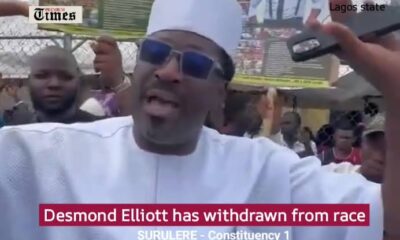



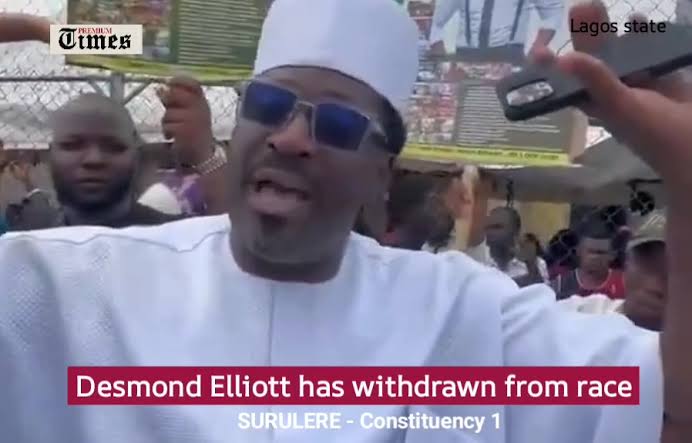
Surulere I lawmaker Desmond Elliot has withdrawn from the All Progressives Congress Lagos House of Assembly primaries, citing intimidation across multiple zones.
In a viral video posted online, the lawmaker said he was stepping out of the race despite seeking re-election under the APC. He alleged that his supporters faced intimidation during the process in several parts of the constituency.
Elliot’s decision came as the primaries held across Lagos on Tuesday. Chief of Staff to the President Femi Gbajabiamila, who represents Surulere Federal Constituency, praised the conduct of the exercise in Surulere, describing it as peaceful.
The withdrawal narrows the contest for the APC ticket in Surulere I ahead of the 2027 general election. Party officials in Lagos have not yet responded to Elliot’s claims, and the APC state chapter has not announced whether the primary in the constituency will proceed with other aspirants.
Elliot has represented Surulere I in the Lagos State House of Assembly since 2015.
https://www.instagram.com/reel/DYkCaAiMxxt/?igsh=ZWw5czl6MHJhNnRy
Politics
Political Shockwave in Rivers as Fubara Pulls Out of APC Governorship Race, Backs Party’s Candidate
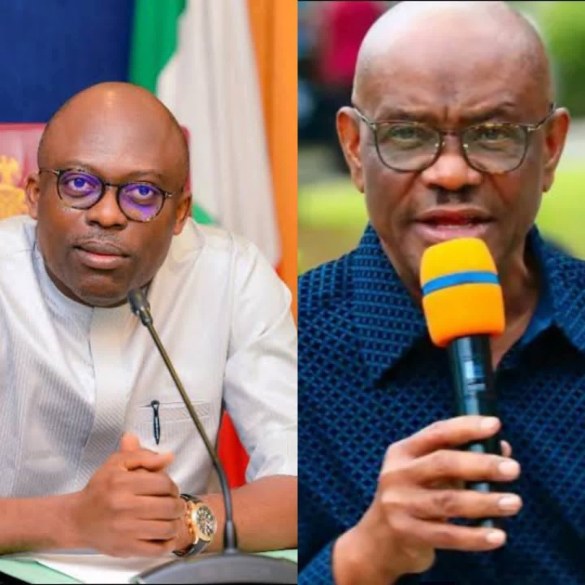
Rivers State Governor, Siminalayi Fubara, has officially withdrawn from the All Progressives Congress (APC) governorship primaries scheduled to take place on Thursday, a development that has stirred fresh political conversations across the state.
The governor announced his decision in a personally signed statement titled “My Decision to Withdraw from the Rivers State Gubernatorial Primaries,” which was released on Wednesday night.
In the statement, Fubara explained that his withdrawal followed wide consultations with political associates, stakeholders, and supporters. He stated that the decision was taken in the overall interest of peace, unity, and stability within the APC and Rivers State at large.
According to the governor, politics should not be allowed to divide the people or create unnecessary tension within the party. He stressed that preserving unity among party members and maintaining stability in the state remain more important than personal political ambition.
Fubara further pledged his total loyalty and support to whoever eventually emerges as the APC governorship candidate, assuring party faithful that he remains committed to the success and progress of the party ahead of the next general elections.
The Rivers governor also appreciated his supporters across the state for standing by him throughout the political process. He thanked party leaders, youth groups, women supporters, and political associates who had continued to show him solidarity and encouragement.
He urged his supporters not to see his withdrawal as the end of his political journey, but rather as a decision made in the collective interest of the party and the state. He also appealed to them to remain peaceful, united, and committed to the ideals of the APC.
Political observers have described the development as one of the biggest political surprises in Rivers State in recent times, especially considering the growing speculations and intense political alignments ahead of the governorship primaries.
Analysts believe the governor’s withdrawal may reshape the political calculations within the APC and influence the direction of the party’s governorship race moving forward.
The announcement has continued to generate mixed reactions from political stakeholders and residents across Rivers State. While some supporters described the move as strategic and mature, others expressed surprise over the governor’s sudden exit from the contest.
Several party faithful, however, commended Fubara for placing party unity and stability above personal ambition, noting that his decision may help reduce internal tensions and strengthen the APC ahead of the elections.
The development has also intensified attention on the remaining aspirants contesting for the APC governorship ticket, as consultations and political meetings continue ahead of the primary election.
Many observers believe the governor’s endorsement of the eventual APC candidate could play a major role in shaping the outcome of the party’s governorship battle and future political structure in the state.
As political activities continue to gather momentum in Rivers State, all eyes are now on the APC primaries and the next phase of political developments expected to unfold in the coming days.
Politics
Ugochukwu Obodo wins Owerri Municipal APC ticket again as APC Elects 27 Imo Assembly Candidates After Successful Primaries
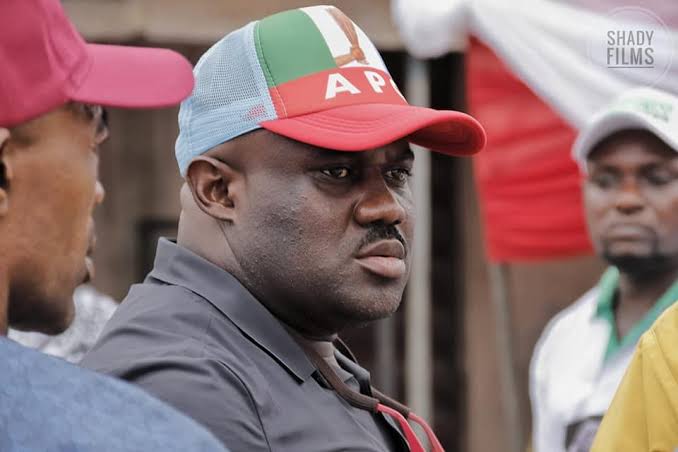
The leadership and members of the All Progressives Congress (APC) in Imo State have successfully elected 27 candidates who emerged victorious during the recently concluded Imo State House of Assembly primary elections conducted across the 305 wards of the State.
In a statement obtained by ThePressman Newspaper, the leadership of Imo APC described the primary election exercise as peaceful, transparent, credible, and reflective of the democratic ideals and internal cohesion of the party.
The information from the party commended party faithful, delegates, stakeholders, and supporters for their maturity, discipline, unity, and sportsmanship throughout the electoral process, noting that the successful conduct of the primaries further demonstrated the organizational strength and readiness of the APC ahead of the 2027 general elections.
According to the statement, the outcome of the primaries reaffirmed the confidence reposed in the party by members across the State, while also positioning the APC for a formidable outing in the forthcoming elections.
The Imo APC leadership warmly congratulated the party’s standard bearers who emerged across the 27 State Constituencies, namely:
Uchenna Osigwe – Orsu LGA
Chantel Adanna Onwumere – Ikeduru
Obodo Ugochukwu – Owerri Municipal
Hon. Ernest Udeze – Ideato North
Godspower Onyeibe – Ideato South
Mrs Julie Egbo – Owerri North
Rt. Hon. Kanayo Onyemaechi – Owerri West
Prince Marcel Amadioha – Ohaji Egbema
Hon. Gilbert Nwosu – Oguta
Hon. Uche Obiozor – Oru East
Hon. Emeka Agbor – Oru West
Rt. Hon. Obinna Egu – Ngor-Okpala
Hon. Magnus Okolie – Orlu
Hon. Innocent Ikpamezie – Mbaitoli
Hon. Modestus Osakwe – Isu
Hon.Ebonine Ozioma Worship – Njaba
Rt Hon Amarachi Chyna Iwuanyanwu – Nwangele
Hon. Chisom Ojukwu – Nkwerre
Hon. Doris Anyanwu – Ahiazu Mbaise
Hon. Princewill Amuchie – Aboh Mbaise
Hon. Henry Agbasonu – Ezinihitte Mbaise
Hon. Sam Osuji – Isiala Mbano
Ben Ozoemenam – Ehime Mbano
Hon. Emeka Okoronkwo – Okigwe
Prince Humphrey Okeke – Obowo
Lady Blessing Nwoba – Ihitte-Uboma
Hon. Chibuzor Umunnakwe – Onuimo
The party further expressed confidence that the emergence of the candidates would strengthen the APC’s chances of securing victory across the State during the 2027 general elections.

Breaking: Tinubu Appoints 39 Year Old Professor As New Jamb Registrar

Desmond Elliot Withdraws from APC Lagos Assembly Primaries, Cites Intimidation

Political Shockwave in Rivers as Fubara Pulls Out of APC Governorship Race, Backs Party’s Candidate

-
Business2 years ago
US court acquits Air Peace boss, slams Mayfield $4000 fine
-

 Trending2 years ago
NYA demands release of ‘abducted’ Imo chairman, preaches good governance
-

 Politics2 years ago
Mexico’s new president causes concern just weeks before the US elections
-

 Politics2 years ago
Putin invites 20 world leaders
-

 Politics2 years ago
Russia bans imports of agro-products from Kazakhstan after refusal to join BRICS
-
Entertainment2 years ago
Bobrisky falls ill in police custody, rushed to hospital
-
Entertainment2 years ago
Bobrisky transferred from Immigration to FCID, spends night behind bars
-
Education2 years ago
GOVERNOR FUBARA APPOINTS COUNCIL MEMBERS FOR KEN SARO-WIWA POLYTECHNIC BORI