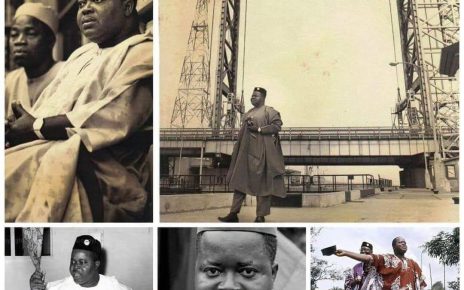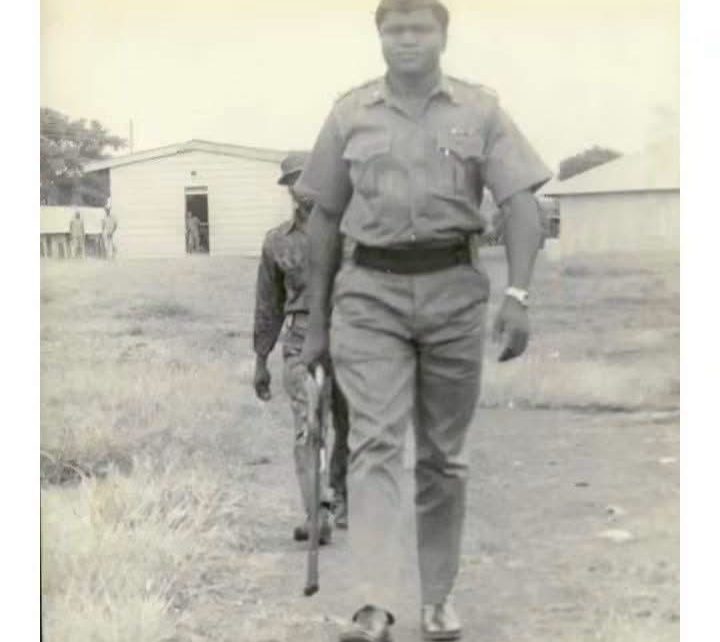
Colonel Anthony Aboki Ochefu was one of the Nigerian Army officers whose career passed through some of the most consequential periods in Nigeria’s military history.
A veteran of the Nigerian Civil War, a senior military police officer and one of the officers involved in the 29 July 1975 coup that removed General Yakubu Gowon, Ochefu was rewarded with the governorship of East Central State after the change of government.
Yet his tenure was remarkably brief.
Within months, he was retired from the Army and removed from office. More than two decades later, he would meet a violent end in his home region.
FROM THE ARMY TO THE CIVIL WAR
Available biographical records give Ochefu’s year of birth as 1934 and identify him as being from the Idoma area. According to the Biographical Legacy and Research Foundation, he enlisted in the Nigerian Army at the age of 15 and was commissioned as an officer in 1961. He subsequently served in Cameroon, the Congo and Nigeria.
By the time Nigeria entered the Civil War in 1967, Ochefu was already an experienced officer.
During the conflict, he commanded a battalion involved in clearing Biafran forces from parts of the former Mid-Western Region. Accounts of his military career describe operations around Koko, Sapele and Warri, followed by an advance northwards to link up with Lieutenant Colonel Murtala Mohammed’s 2nd Division.
His troops were subsequently involved in a seaborne operation in the Niger Delta and the capture of Creek Town.
The Civil War period therefore established Ochefu as a field commander before he moved into increasingly senior military appointments.
COMMANDING THE LAGOS GARRISON
Ochefu’s career continued to rise after the war.
The Biographical Legacy and Research Foundation records him as Commanding Officer of the Lagos Garrison Organisation from 1968 to 1970 and later as Provost Marshal of the Army. It records his appointment as Provost Marshal from 1970, continuing into the period of the 1975 coup.
His position placed him close to the centre of military power.
By 1975, Nigeria was still under the government of General Yakubu Gowon, who had been Head of State since the counter-coup of July 1966 and had led the country through the Civil War.
But dissatisfaction within sections of the military eventually produced another change of government.
THE 1975 COUP
On 29 July 1975, while Gowon was attending an Organisation of African Unity summit in Kampala, a group of military officers overthrew his government.
Anthony Ochefu was among the officers associated with the coup.
Historical accounts identify a group of senior officers including Shehu Musa Yar’Adua, Joseph Nanven Garba, Abdullahi Mohammed, Ibrahim Babangida, Muhammadu Buhari and Anthony Ochefu as being involved in the planning or execution of the change of government. Ochefu’s position as Provost Marshal was particularly important, and accounts of the coup describe him as playing a role in bringing Middle Belt officers into the conspiracy.
The plot succeeded.
Gowon was removed and General Murtala Mohammed emerged as the new military Head of State, with Olusegun Obasanjo becoming Chief of Staff, Supreme Military Headquarters.
Unlike some earlier coups, the officers who organised the July 1975 change of government did not install one of their own junior officers as Head of State. Instead, they transferred power to Murtala Mohammed, a senior general who was widely seen as having the authority to lead the new administration.
Ochefu was rewarded with a governorship.
GOVERNOR OF EAST CENTRAL STATE
Following the coup, Ochefu was appointed Military Governor of East Central State, succeeding Anthony Ukpabi Asika, who had administered the state since 1967.
His appointment placed him in charge of a region still dealing with the enormous consequences of the Civil War.
East Central State had been one of the principal theatres of the conflict. Its economy, public institutions and infrastructure had suffered heavily during the war, while the post-war administration faced the difficult task of rebuilding the region.
Ochefu’s administration was brief, but records attribute at least some institutional decisions to his tenure.
For example, accounts of the history of the National Orthopaedic Hospital in Enugu state that the newly opened Haile Selassie I Institute was renamed the State Orthopaedic Hospital during Ochefu’s tenure in July 1975.
But his time in government would soon come to an abrupt end.
RETIRED AFTER ONLY MONTHS IN OFFICE
Ochefu’s governorship lasted only a few months.
The Biographical Legacy and Research Foundation, drawing on Who is Who in Nigeria (1978), records that he was retired from the Army on 27 November 1975.
A contemporary issue of the Nigeria Year Book also referred to him as the retired Military Governor of East Central State in late November 1975.
Accounts differ over precisely how his removal should be interpreted.
Some later biographies connect his retirement to his earlier conduct as Commanding Officer of the Lagos Garrison Organisation, while other accounts have associated his removal with disagreements surrounding the new military administration.
What is firmly established is that Ochefu was no longer governor by the end of November 1975.
He was succeeded in East Central State by Lieutenant Colonel John Atom Kpera. The later division of East Central State into Anambra and Imo occurred in March 1976, several months after Ochefu had left office.
Thus, the claim that Ochefu governed East Central State until February 1976 is repeated in some secondary biographies, but the stronger contemporary biographical evidence places his retirement in November 1975.
A QUIET PERIOD AFTER THE ARMY
After his retirement, Ochefu largely disappeared from national public life.
He had risen rapidly through the Army, commanded troops during the Civil War, served in senior military positions, helped bring down one military government and briefly administered one of the country’s largest states.
Yet the political prominence that followed the 1975 coup did not last.
For the next two decades, his name appeared far less frequently in public affairs.
Then, in 1999, his life ended violently.
KILLED AT A PETROL STATION
On 25 November 1999, Colonel Anthony Aboki Ochefu was shot dead at a petrol station in Oturkpo, Benue State.
He was about 65 years old. Contemporary and later accounts state that the police arrested several suspects in connection with the killing, but the investigation did not ultimately produce a definitive resolution of the case.
Academic discussions of policing in Nigeria later cited Ochefu’s murder as an example of the difficulties surrounding the investigation and prosecution of politically sensitive killings. Reports stated that seven suspected killers were arrested but subsequently released, while questions remained over the handling of the investigation.
The circumstances surrounding his killing therefore remain part of the unresolved history surrounding his final years.
A LIFE ACROSS NIGERIA’S MILITARY HISTORY
Anthony Ochefu’s life followed an extraordinary path through modern Nigerian history.
He joined the Army as a teenager, received his commission in 1961, served overseas and in Nigeria, commanded troops during the Civil War and rose to become Provost Marshal.
In July 1975, he became one of the officers involved in the military coup that removed Yakubu Gowon.
For his role in the new order, he was appointed Military Governor of East Central State.
But the reward lasted only a few months.
By November 1975, he had been retired from the Army and had left the governorship. More than 20 years later, the former governor was killed in Oturkpo.
His story illustrates the instability and rapid reversals that characterised Nigeria’s military era: officers who helped create governments could themselves be removed from power within months, while the alliances formed during one political crisis could change dramatically in the next.
Colonel Anthony Aboki Ochefu therefore occupies a distinctive place in Nigeria’s history — a soldier of the Civil War, a participant in the 1975 overthrow of Gowon and the brief military governor of East Central State whose career ended almost as quickly as it had risen.
Photograph: Colonel Anthony Aboki Ochefu.
Photograph credit: Clara Dike Wall.
Sources
Biographical Legacy and Research Foundation, Anthony Aboki Ochefu, drawing on Who is Who in Nigeria (1978).
The Nigeria Year Book, contemporary record of Ochefu’s retirement and subsequent public statement.
World Statesmen, Nigerian States, historical chronology of East Central State and its administrators.
Idoma Voice, biographical accounts of Colonel Anthony Ochefu’s military career and 1975 governorship.
Emmanuel C. Onyeozili, “Obstacles to Effective Policing in Nigeria”, African Journal of Criminology and Justice Studies, discussing the unresolved investigation surrounding Ochefu’s 1999 killing.
Historical accounts of the July 1975 military coup and Ochefu’s role in the change of government.