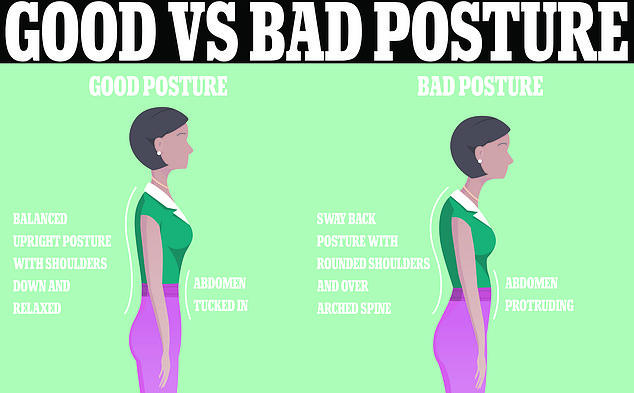
The next time you’re struggling to fall asleep, don’t blame your lumpy pillows—it could be down to how you’ve been sitting and standing all day.
A leading sleep expert says hours spent hunched over screens are putting strain on the body’s musculoskeletal system, disrupting rest and fuelling insomnia.
Lisa Artis, Deputy CEO of The Sleep Charity, told the Daily Mail: ‘Poor posture from daytime screen use can have lasting effects, into the night.
‘If you’re already in pain, you’re also less likely to reach the deep sleep your body needs to recover—it’s a vicious cycle.’
Her comments come as new research from Simbarevealed millions of Britons are suffering from ‘tech neck’, a term for tension in the upper back caused by being slumped over as we stare at our phones, tablets and computers.
But the effects of tech neck don’t vanish once we’ve put our phones away for the night.
A survey carried out by the mattress brand found that half of Britons are in regular neck or back pain that ruins their rest.
Because of the unnatural positions we’ve spent hours in, it’s not uncommon for aches and twinges to begin in earnest the moment our body gets the chance to unfurl.
These can be painful, and stop us from lying down flat on our backs in a natural way, prompting us to pick up equally problematic positions once we’ve hit the sack.
Ms Artis explained: ‘If your neck and shoulders are tight from phone use, sleeping on your stomach makes things worse by twisting the spine and straining the shoulders.
‘Side sleeping without good pillow support can also exaggerate tech neck.
‘The best positions are lying on your back or side with the head, neck, and spine aligned.’
It’s estimated that around a third of Britons experience insomnia, and with more and more studies linking poor sleep with a plethora of life limiting conditions and diseases, including kidney and heart disease, high blood pressure, diabetes and stroke.
Insomnia has also been shown to negatively impact memory and the ability to retain new information, which has been linked to the development of dementia.
This is because during sleep, the brain clears out daily metabolic toxins and transfers short-term memories into long-term storage, solidifying learning.

In 2023, Furniture At Work revealed what home-workers could look like by the year 2100, because of consistent use of technology, screen exposure and poor posture

Their model, dubbed Anna, has a hunchback, dark, swollen eyes

Their model, dubbed Anna, has fallen victim to weight gain, a weak immune system thanks to insufficient fresh air, anxiety and depression

Their model, dubbed Anna, has fallen victim to weight gain, a weak immune system thanks to insufficient fresh air, anxiety and depression
Inadequate sleep disrupts these critical processes, which is why chronic sleep loss is strongly linked to an increased risk of neurodegenerative diseases like Alzheimer’s.
Poor sleep, getting the wrong amount or having a sleep disorder like sleep apnea can shorten a person’s lifetime, with some studies showing it shaves off 4.7 years for women and 2.4 years for men.
The idea that looking at our phones can cause structural issues in our bodies might seem outlandish, but holding your head upright puts around 5kg of pressure on your neck.
Meanwhile, tilting your head to look at your phone can pile up to 22kg of extra strain on the vertebrae between your skull and shoulders.
Ms Artis added that the extra weight and pressure can trigger a negative ripple effect all the way down to your pelvis.
She said: ‘Spending hours hunched over a phone puts extra strain on the neck, shoulders and spine.
‘When you crane forward to check your phone, it’s not just your neck and shoulders working harder—your lower back is pulled out of position too.
‘Slouching in the lower spine shifts the body’s balance upward, creating tension in the shoulders and neck.
‘This chain reaction means shoulder pain can actually be a symptom of poor posture in the lower back, caused by too much time bent over screens.
‘Over time, this can lead to chronic pain, headaches, reduced mobility, and poor circulation.’
Thankfully you can improve your posture, but it takes commitment and—if your tech neck is particularly bad—some discomfort.
Ms Artis said: ‘Good posture helps counteract these effects, keeping the spine neutral, muscles balanced, and energy levels higher.
‘Sitting still for too long tightens everything up—especially around your neck and shoulders.
‘Take mini movement breaks every 45 minutes to an hour. Stand up, stretch, or roll your shoulders.
‘You’ll boost blood flow and ease off the tension before it has a chance to build.’
Ms Artis firmly believes that making better daytime choices—in how we sit, move and use our electronic devices—sets our bodies up for better, deeper sleep.
But it’s important to note that excessive sleep can also bring its own problems.
Oversleeping also has links to heart disease, weight gain, diabetes, cognitive impairment and depression.
Spending excessive time in bed can also disrupt the body’s natural sleep-wake rhythms, causing a groggy and disoriented feeling upon waking.