
Business
AFDB REAFFIRMS $2.2 BILLION PLEDGE AS VP SHETTIMA COMMISSIONS 2ND SAPZ IN CROSS RIVER ** Says agro-industrial processing zones will empower farmers, attract investors, diversify Nigeria’s economy


STATE HOUSE PRESS RELEASE
AFDB REAFFIRMS $2.2 BILLION PLEDGE AS VP SHETTIMA COMMISSIONS 2ND SAPZ IN CROSS RIVER
** Says agro-industrial processing zones will empower farmers, attract investors, diversify Nigeria’s economy
The federal government has commenced construction of the Special Agro-Industrial Processing Zone in Calabar, Cross River State, as part of a nationwide drive to transform the agricultural sector and stimulate inclusive economic growth across Nigeria.
This is the second of such a facility initiated within 72 hours after Vice President Kashim Shettima had on Tuesday performed the groundbreaking ceremony for the construction of the Kaduna State SAPZ in the Chikun local government area of the state.
Already, the AfDB_Group has reaffirmed its commitment to mobilising an additional $2.2 billion to execute the second phase of the SAPZ project across 28 states in Nigeria.
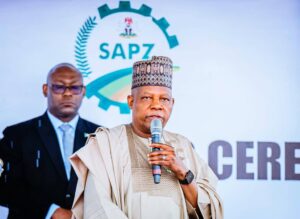
Speaking on Thursday when he performed the groundbreaking ceremony of SAPZ in Calabar, the Vice President described the project as “a game changer” that aligns with the President Tinubu administration’s Renewed Hope Agenda, aimed at diversifying the nation’s economy, addressing food security, tackling rural unemployment, as well as empowering farmers and the youth population.
“There is no intervention more practical in our dream of a nation where the potential of agriculture is maximised than what’s brought us together today. This isn’t just a project—it’s a bold vision to transform Nigeria’s agricultural value chain,” VP Shettima said.
According to him, the SAPZ initiative, supported with counterpart funding from development partners and the private sector, is designed to address challenges that have long hindered the growth of Nigeria’s agricultural economy, including inadequate processing infrastructure, limited access to markets, and rural unemployment.
“For far too long, our farmers have contended with poor infrastructure, lack of access to finance, and inadequate processing facilities. This zone is designed to confront those challenges head-on by creating an ecosystem where innovation, investment, and collaboration thrive,” he noted.
VP Shettima explained that the Calabar SAPZ will serve as a hub for agro-processing and storage, providing farmers and agripreneurs with critical infrastructure to scale their operations and tap into local and international markets.
“This is where farmers will meet with private investors, where ideas will turn into enterprise, and where our youth will find meaningful opportunities,” he said, disclosing that the Tinubu administration has classified SAPZ as a priority program in Nigeria’s quest for food security, with plans to institutionalize it as a government agency that will facilitate agricultural industrialization across all 36 states.
“These zones will generate thousands of jobs. They will create opportunities for young people, empower them with skills and knowledge to engage in meaningful work and help them contribute positively to the economy. Cross Riverians, development has come to your doorstep. For you and for the country, SAPZ is a game changer—one that will enable Nigeria to diversify its economy with a sustainable source.,” he stated.
Senator Shettima also expressed gratitude to key international development partners, including the African Development Bank, the Islamic Development Bank, and the International Fund for Agricultural Development, for their support and belief in Nigeria’s vision.
The Vice President commended Cross River State Governor, Senator Prince Bassey Edet Otu, for his collaboration, describing him as “a critical foundation for the success of this intervention and a great ally in development.”
Earlier, Cross River State Governor, Senator Otu, said the programme marked a watershed in the ongoing bid by his administration to establish the renewable resource base of the state through the full utilisation of agriculture and its multiple value chain.
Otu pointed out that in Cross River State, the establishment of a cluster of smallholder farmers in cash crops such as rice, cassava, millet, and cocoa across the state is the right step towards the agro-industrial revolution.
He said the paradigm shift from a non-renewable to a renewable resource base also holds the key to the prosperity of many nations, hence the imperative to join the league of sub-nationals in Nigeria that have adopted agriculture as the mainstay of their economy.
“The deliverables of the envisaged projects are food security, diversification of the state economy towards export-oriented trajectory and increase in the State’s GDP. When these projects are fully operational there is an expected robust collaboration with reputable agro-based processing institutes, universities and the rest, aimed at accelerating breakthroughs in many agro-industrial production.”
Also, Minister of Agriculture and Food Security, Senator Abubakar Kyari, said the programme would transform the agricultural production and agro-investment landscape in Nigeria under the Renewed Hope Agenda of President Tinubu.
Kyari thanked Vice President Shettima for his leadership and political backing at the highest level in the implementation of the SAPZ in Nigeria, just as he also commended the Governor of Cross River State for his commitment to ensuring that the state is among the front-running states that will commence the construction of their Agro-Industrial Processing Hub.
In his remark, President of AfDB, Dr Akinwumi Adesina, reiterated the bank’s pledge to mobilise $2.2 billion to execute the SAPZ project in 28 states across Nigeria.
Adesina observed that Cross River State has a significant role to play in Nigeria’s agricultural transformation because of the vast production of cocoa, cassava, rice and banana in the state, saying Obudu Cattle Ranch alone can turn the state into a huge livestock producer.
He also acknowledged that the state is ideal for SAPZ because it has an export processing zone, ports facility, and export handling capabilities, adding that the SAPZ in Calabar can easily be linked to the seaport for the transportation of processed agricultural commodities to the export market in neighbouring countries, including Cameroon and the rest.
“The African Development Bank, as you know, is spearheading this together with our partners, which include the Islamic Development Bank and the International Fund for Agricultural Development, and we have put together $934 million from the African Development Bank, with core financing of $938 million from these partners.
“The first phase of SAPZ in Nigeria will be in eight states of Cross River, Kaduna, Kano, Katsina, Oyo, Ogun, Kwara, Imo and the Federal Capital Territory. We are delighted with our partnership with the Islamic Development Bank and the International Fund for Agricultural Development.
“We have put together a financing package of $510 million to make this work. We expect, in the second phase of this, to mobilise $2.2 billion to be able to work for 28 states across the federation with several partners,” the AfDB President said.




Stanley Nkwocha
Senior Special Assistant to The President on Media & Communications
(Office of The Vice President)
10th April, 2025










The Trade Union of Nigeria, TUC, has raised the alarm that the price of Premium Motor Spirit aka Petrol may climb to about N2,000 per litre if urgent measures are not taken to cushion the impact of rising global crude prices and the depreciating naira.
Speaking to newsmen on Thursday, April 9, the president of the TUC, Festus Osifo, called on the Federal Government to immediately deploy 60 percent of excess crude oil revenue above the 2026 budget benchmark to subsidise crude feedstock supplies to the Dangote Refinery and other modular refineries, a move it says will slash pump prices of petrol, diesel, and jet fuel within two weeks
“Today, comrades, we are seeing that the cost of petrol is edging towards N2,000 per litre depending on the part of the country that you are. Nigerian workers are already passing through excruciating pain as we speak.
The same way it is affecting transportation, it is also affecting manufacturing. The cost of diesel has also gone northward, meaning that the cost of production has increased. When production costs rise, the final price of goods on the shelves will also skyrocket.
If this continues unchecked, the inflation that we are currently celebrating as going downwards will reverse and start moving up again,” he stated.
Osifo outlined the proposal as an urgent intervention to cushion Nigerian workers from excruciating pain caused by petrol prices edging towards ₦2,000 per litre in some parts of the country

The governor of Oyo state, Seyi Makinde, has approved a N10,000 transportation allowance as a palliative for the state workforce to cushion the effects of the increase in the pump price of Premium Motor Spirit, otherwise known as petrol.
The Chairman of the Nigeria Labour Congress (NLC), Oyo State chapter, Kayode Martins, in a statement released on Monday, March 23, disclosed that the governor has granted the request of the union on the issue of transportation allowance.
The statement read
“Following the intervention and formal request made by the State Council of the Nigeria Labour Congress (NLC) earlier this morning, the state government has approved a N10,000 transportation allowance for all workers in the state.
The newly approved allowance is set to take effect from April 2026, providing much-needed relief to workers grappling with rising transportation costs amid current economic challenges.
This development comes as a direct response to sustained advocacy by the state NLC, aimed at cushioning the impact of increased living expenses on the workforce.
Further details on implementation are expected to be communicated by the relevant government authorities in due course.”

The Central Bank of Nigeria (CBN), has declared that banks and financial institutions must establish and maintain a temporary watch-list for Bank Verification Numbers (BVN) implicated in suspected fraudulent transactions.
According to the CBN in a circular dated March 12, 2026 and signed by its Director of Payments System Policy Department, Musa I. Jimoh, the apex bank said such a suspected BVN may remain on the temporary watchlist for a maximum period of twenty-four (24) hours during which the owner would be contacted to make clarifications.
The circular explained that the move is part of several new measures under a revised regulatory framework aimed at enhancing financial system stability.
“A BVN may remain on this temporary Watchlist for a maximum period of twenty-four (24) hours, during this period, the BVN owner shall be contacted to provide clarification regarding the identified transaction(s),” the circular stated.
The circular also sets an age requirement for BVN enrolment, restricting registration to individuals who have attained eighteen (18) years and above.
The CBN also added that amendments to phone numbers linked to a BVN shall be allowed only once.
“Amendments to phone numbers linked to a BVN shall be allowed only once,” the circular noted.
The apex bank stated that access to BVN databases will remain tightly controlled.
“Access to the BVN databases shall be exclusively granted to Central Bank of Nigeria (CBN) licensed financial institutions.
“Notwithstanding this provision, the Central Bank of Nigeria (the Bank) reserves the right to approve access to the BVN databases in extenuating circumstances and in accordance with the provisions of extant laws,” the circular said.
Financial institutions are expected to comply with the new requirements, and customers may be contacted by their banks if their BVNs are temporarily flagged during the new fraud monitoring process.
The new policy, as stated by the CBN, takes effect from May 1, 2026.

2027: More Than 50 Lawmakers Lose APC Reps Tickets in Major Primary Election

Bandits behind Ogbomoso school abduction will face full wrath of the law- President Tinubu

PDP to screen Goodluck Jonathan on Tuesday as its sole Presidential aspirant For 2027 race

-
Business2 years ago
US court acquits Air Peace boss, slams Mayfield $4000 fine
-

 Trending2 years ago
NYA demands release of ‘abducted’ Imo chairman, preaches good governance
-

 Politics2 years ago
Mexico’s new president causes concern just weeks before the US elections
-

 Politics2 years ago
Putin invites 20 world leaders
-

 Politics2 years ago
Russia bans imports of agro-products from Kazakhstan after refusal to join BRICS
-
Entertainment2 years ago
Bobrisky falls ill in police custody, rushed to hospital
-
Entertainment2 years ago
Bobrisky transferred from Immigration to FCID, spends night behind bars
-
Education2 years ago
GOVERNOR FUBARA APPOINTS COUNCIL MEMBERS FOR KEN SARO-WIWA POLYTECHNIC BORI