
Columns
Augustine Azuka “Jay-Jay” Okocha is a legendary figure in the world of football, widely regarded as one of Africa’s greatest players and a master of flair, creativity, and sheer skill.

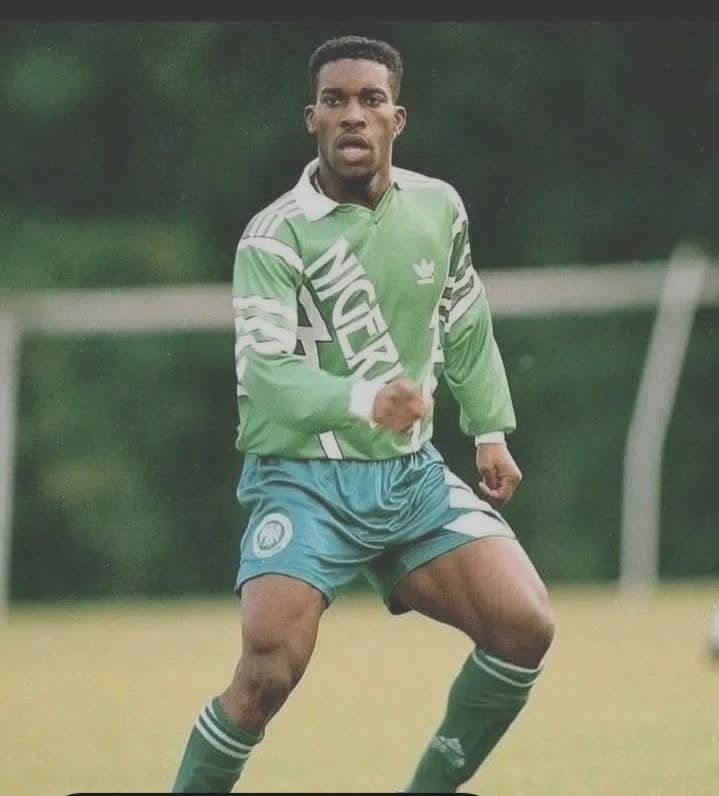
Born in Enugu, Nigeria, in 1973, Okocha mesmerized fans around the globe with his dazzling footwork, unpredictable dribbling, and joyous style of play that made football look effortless and fun.
A Midfield Maestro
Okocha played primarily as an attacking midfielder, where his ability to control the tempo of a match, deliver pin-point passes, and beat defenders with ease earned him global acclaim. His signature moves—stepovers, flicks, feints, and no-look passes—captivated audiences and often left opponents flat-footed. He wasn’t just a showman; he was a game-changer.
National Pride and Leadership
He was a longtime stalwart of the Nigerian national team, the Super Eagles, where he rose to the rank of captain. Okocha played a crucial role in some of Nigeria’s most memorable football moments, including their 1994 Africa Cup of Nations (AFCON) victory, the 1996 Olympic gold medal win, and Nigeria’s historic 1994 FIFA World Cup debut. His leadership on and off the pitch made him a beloved figure not only in Nigeria but across Africa.
Club Career Highlights
Jay-Jay Okocha had an illustrious club career across Europe. He played for several top clubs, including:
Eintracht Frankfurt in Germany, where he first gained international attention.
Paris Saint-Germain (PSG) in France, where he dazzled fans and shared the field with future stars like Ronaldinho.
Bolton Wanderers in the English Premier League, where he became a cult hero, even captaining the side and leading them to a League Cup final.
At every club he played for, Okocha was known not just for his talent but for his sportsmanship, charisma, and leadership.
Global Impact and Legacy
Okocha’s impact went far beyond Nigeria. He inspired a generation of African footballers and left an indelible mark on the global game. His style of play continues to influence young players who see football not just as competition, but as art in motion. His famous quote—”I’m so good they named me twice”—captures the confidence and charm that made him a fan favorite.
The image in question likely shows Okocha in action for Nigeria, with the “NIGERI” text visible on his jersey—a timeless representation of national pride, skill, and legacy.
Jay-Jay Okocha remains a living legend, a footballer whose magic still echoes in highlight reels and in the hearts of fans around the world.





How Samuel Johnson and Obadiah Johnson preserved Yoruba history while advancing early Western medicine in colonial Nigeria.
A Historic Family Legacy
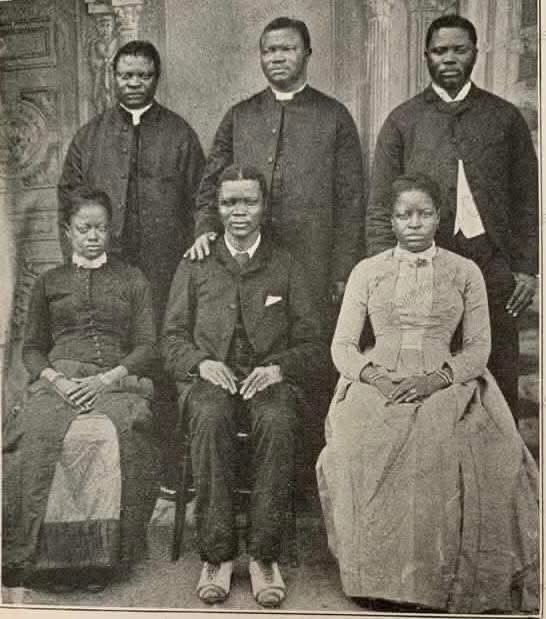
The Johnson family occupies a significant place in the intellectual and cultural history of the Yoruba people. A well-known family photograph from the late nineteenth century shows members of this influential household. Standing at the back is Samuel Johnson, the author of one of the most important historical works on Yoruba civilisation. Seated at the far right is his younger brother Obadiah Johnson (1849–1920), one of the earliest Western-trained Nigerian doctors and the man responsible for ensuring the eventual publication of his brother’s historical masterpiece.
Together, the brothers played crucial roles in preserving Yoruba history and advancing professional medicine during the colonial era.
Origins in Sierra Leone
The Johnson brothers were born in Freetown into a family of liberated Africans, also known as recaptives—Africans who had been freed from slave ships by the British navy and resettled in Sierra Leone during the nineteenth century.
Their parents were of Yoruba people origin and traced their ancestry to the Oyo Empire, one of the most powerful pre-colonial Yoruba states.
Freetown at the time had become an important centre of education and Christian missionary activity in West Africa. It was within this environment that the Johnson brothers received their early education and intellectual formation.
Samuel Johnson: Historian of the Yorubas
Samuel Johnson (1846–1901) was a clergyman of the Church Missionary Society and a passionate historian dedicated to documenting the origins and political evolution of the Yoruba people.
Concerned that Yoruba history was largely preserved only through oral tradition, Johnson began compiling historical records in the 1870s. Over the next two decades, he travelled widely across Yoruba towns, interviewing chiefs, elders, and traditional historians.
His goal was to document:
the origins of Yoruba kingdoms
the rise and fall of major dynasties
political conflicts among Yoruba states
cultural traditions and institutions
After more than twenty years of research, Johnson completed his manuscript in 1897, titled A History of the Yorubas from the Earliest Times to the Beginning of the British Protectorate.
The Lost Manuscript
Despite completing the manuscript, Samuel Johnson never saw his work published.
The only copy of the manuscript was sent to London for printing. However, it was reportedly lost during the publishing process. This devastating loss meant that the years of painstaking historical research appeared to have vanished.
Samuel Johnson died in 1901, believing that his life’s work had been permanently lost.
Obadiah Johnson: Physician and Editor
Samuel’s younger brother, Dr. Obadiah Johnson, played a decisive role in rescuing the manuscript.
Born in 1849, Obadiah Johnson pursued a career in medicine and travelled to Edinburgh to study at the University of Edinburgh, one of the world’s leading medical institutions at the time.
He earned:
M.B., C.M. degree in 1886
M.D. degree in 1889
These achievements made him one of the earliest Nigerians to obtain a Western medical degree.
After completing his studies, he returned to West Africa and served in the colonial medical service. Between 1890 and 1897, he worked as Chief Medical Officer in Lagos, which was then an important administrative centre of British colonial rule.
Reconstructing a Lost History
Determined that his brother’s historical research should not disappear, Obadiah Johnson undertook the extraordinary task of reconstructing the lost manuscript.
Using:
surviving notes
personal recollections
earlier drafts
contributions from Samuel’s research network
he painstakingly rebuilt the text. He also edited and prepared the manuscript for publication.
Unfortunately, Obadiah Johnson did not live to see the book printed. He died in 1920, shortly before its publication.
Publication of a Foundational Historical Work
In 1921, the reconstructed manuscript was finally published in London by George Routledge & Sons.
The book, A History of the Yorubas, quickly became one of the most influential historical texts on Yoruba civilisation and remains widely cited by scholars today.
The work provides detailed accounts of:
the founding myths of the Yoruba people
the political structure of the Oyo Empire
wars among Yoruba states during the nineteenth century
the early encounters with European missionaries and colonial administrators
Because of its depth and documentation, the book remains a cornerstone of African historiography.
Lasting Legacy
The Johnson brothers left a lasting intellectual legacy that extends far beyond their lifetimes.
Samuel Johnson’s dedication to documenting Yoruba history ensured that important traditions and political narratives were preserved for future generations. His work remains essential for historians studying Yoruba society and pre-colonial West Africa.
Meanwhile, Obadiah Johnson’s achievements in medicine and public health positioned him among the early pioneers of Western medical practice in Nigeria. His determination to preserve his brother’s work ensured that one of the most significant historical texts about the Yoruba people survived.
Today, A History of the Yorubas continues to influence historians, anthropologists, and scholars studying African history, ensuring that the Johnson brothers remain central figures in Nigeria’s intellectual heritage.
Sources
A History of the Yorubas from the Earliest Times to the Beginning of the British Protectorate by Samuel Johnson
Academic studies on Yoruba historiography
Records from the University of Edinburgh
Historical archives documenting the Johnson family and early Nigerian intellectual history.
Columns
The Unity Party of Nigeria Governors: Champions of Progressive Governance in the Second Republic
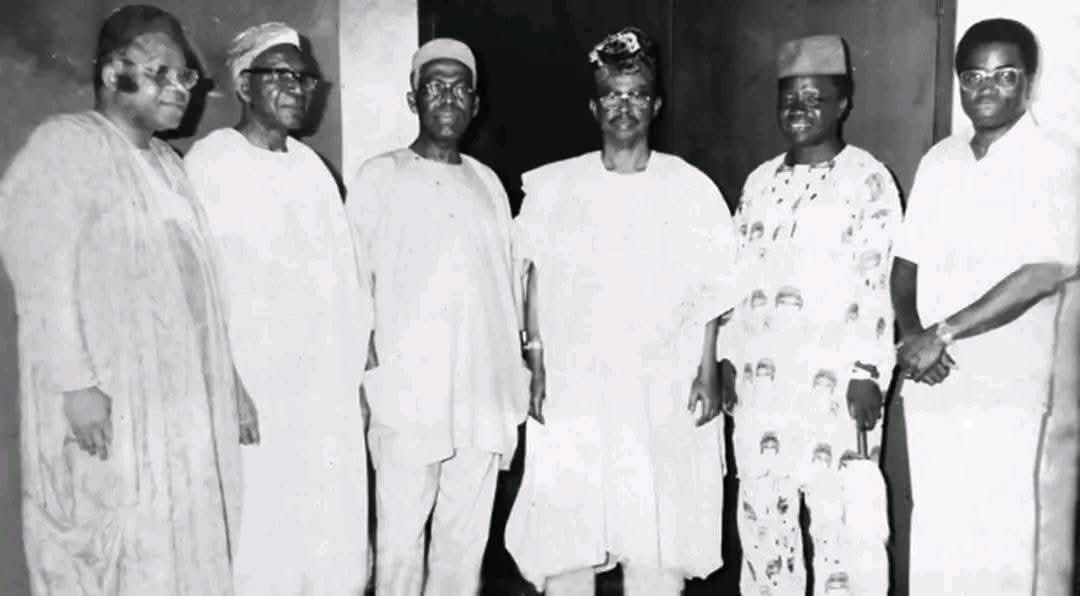
How six leaders inspired by Obafemi Awolowo shaped governance through education, social welfare, and development between 1979 and 1983.
The Unity Party of Nigeria and the Rise of Progressive Politics
The Unity Party of Nigeria (UPN) emerged in 1978 as Nigeria prepared to return to civilian rule after years of military governance. The party was founded and led by Obafemi Awolowo, one of Nigeria’s most influential nationalist leaders and political thinkers.
UPN was built on a four-point cardinal programme that defined its ideological direction:
Free education at all levels
Free healthcare services
Integrated rural development
Full employment opportunities
These policies reflected Awolowo’s long-standing commitment to social welfare and economic empowerment. Many of these ideas had earlier shaped governance in Western Nigeria during the 1950s, when Awolowo led the Action Group government.
During the Nigerian Second Republic (1979–1983), the UPN governed several states in southwestern Nigeria and Bendel State, where its governors attempted to implement these progressive policies.
Ambrose Folorunsho Alli – Governor of Bendel State (1979–1983)
Ambrose Alli was born on 22 September 1929 in Ekpoma. A trained medical doctor and academic, he became the first civilian governor of Bendel State under the UPN platform.
During his administration, Alli prioritised education expansion and rural development. One of his most notable achievements was establishing Bendel State University, which is now known as Ambrose Alli University.
His government also:
Built numerous secondary schools
Expanded healthcare facilities
Improved road networks connecting rural communities
Alli’s policies significantly increased access to education across areas that are now Edo and Delta States.
Legacy: His contributions to education remain widely recognised, particularly through Ambrose Alli University in Ekpoma.
Michael Adekunle Ajasin – Governor of Ondo State (1979–1983)
Michael Adekunle Ajasin was born on 28 November 1908 in Owo. Before entering politics, he worked as an educator and served as principal of Imade College, Owo.
As governor of Ondo State Nigeria, Ajasin strongly implemented the UPN policy of free education.
His administration focused on:
Construction of schools across the state
Teacher training and improved educational facilities
Rural electrification and infrastructure expansion
Despite political challenges during the Second Republic, Ajasin maintained a firm commitment to education as a tool for societal progress.
Legacy: His administration laid foundations that significantly increased literacy and educational access in Ondo State.
Obafemi Awolowo – National Leader of the UPN
Obafemi Awolowo (1909–1987) was the ideological architect behind the UPN and one of Nigeria’s most respected political thinkers.
Born in Ikenne, Awolowo was a lawyer, journalist, and nationalist leader whose political philosophy emphasised education, economic planning, and social welfare.
Although he did not hold executive office during the Second Republic, Awolowo served as the national leader of the UPN, guiding the policies and governance approach of the party’s governors.
His ideas on democratic socialism and regional development influenced Nigerian political thought for decades.
Legacy: Awolowo remains one of the most studied political figures in Nigeria’s history.
Bisi Onabanjo – Governor of Ogun State (1979–1983)
Bisi Onabanjo was born on 13 February 1927 in Ayepe. Before entering politics, he was a journalist known for his articulate writing and commentary.
As governor of Ogun State Nigeria, Onabanjo focused on agriculture, education, and rural development.
His administration established Ogun State University, now known as Olabisi Onabanjo University, which expanded higher education opportunities in the region.
He also invested in road construction to connect agricultural communities to urban markets.
Legacy: Onabanjo’s educational reforms helped strengthen Ogun State’s academic infrastructure.
Lateef Kayode Jakande – Governor of Lagos State (1979–1983)
Lateef Jakande was born on 23 July 1929 in Lagos. Before entering politics, he was a respected journalist and newspaper publisher.
As governor of Lagos State Nigeria, Jakande implemented large-scale social programmes.
His administration achieved:
Massive public housing projects known today as Jakande Estates
Expansion of free education programmes
Construction of numerous schools and public infrastructure
These policies helped accommodate the rapidly growing population of Lagos.
Legacy: Jakande is often remembered as one of Lagos State’s most effective administrators.
Bola Ige – Governor of Oyo State (1979–1983)
Bola Ige was born on 13 September 1930 in Esa-Oke. A lawyer and powerful orator, he became one of Nigeria’s most respected political figures.
As governor of Oyo State Nigeria, Ige pursued policies aligned with Awolowo’s progressive philosophy.
His administration focused on:
Education reform
Expansion of healthcare services
Agricultural development and mechanisation
After leaving office, he remained active in national politics and later served as Nigeria’s Attorney-General and Minister of Justice before his assassination in 2001 in Ibadan.
Legacy: Ige is remembered for his eloquence and commitment to justice, earning the nickname “The Cicero of Esa-Oke.”
The End of the Second Republic
The achievements of the UPN governors were cut short by the 1983 Nigerian military coup, which ended the Second Republic on 31 December 1983.
Despite the abrupt end of civilian rule, the governance model introduced by these leaders remains influential in discussions about public service and development in Nigeria.
Legacy of the UPN Governors
The governors of the Unity Party of Nigeria are often remembered for their people-oriented policies, particularly in education, healthcare, and infrastructure.
Guided by the ideological leadership of Obafemi Awolowo, their administrations demonstrated how state governments could prioritise social welfare and development.
Decades later, their programmes—especially in education and housing—continue to serve as reference points in debates about effective governance in Nigeria.
Sources
The Guardian Nigeria – “UPN Governors and the Second Republic Legacy” (2020)
Vanguard Nigeria – “The Golden Era of Progressive Governance in the South-West” (2019)
Historical records on the Unity Party of Nigeria and the Nigerian Second Republic.

The life and political career of a Lagos lawmaker who rose from grassroots politics to the Nigerian Senate.
Early Life and Background
Adebayo Sikiru Osinowo (28 November 1955 – 15 June 2020), widely known by the nickname “Pepper,” was a Nigerian businessman and politician. He served as a member of the Lagos State House of Assembly and later represented Lagos East Senatorial District in the Nigerian Senate during the 9th National Assembly until his death in 2020.
Osinowo was born in Ijebu-Ode to Alhaji Rabiu Osinowo of Odo-Egbo and Mariamo Taiwo Osinowo. His family roots trace to the Ijebu area of Ogun State in southwestern Nigeria.
For his early education, he attended St. Augustine Primary School in Ijebu-Ode, before proceeding to Isonyin Grammar School in Isonyin, where he completed his secondary education.
Early Professional Career
Osinowo began his professional career in 1977 when he joined the Federal Ministry of Works Nigeria in Lagos as a Land Officer.
He served in that capacity until 1979, gaining administrative and technical experience in land management and government service.
Business Career
After leaving the civil service, Osinowo moved into the private sector, where he established himself in business, particularly in engineering, construction, and dredging services.
He held several leadership roles during his business career, including:
Managing Director, NITAL International (1986–2003)
Managing Director, NIMCO International Co. Ltd (1990–2003)
Managing Director, Extreme Piling and Construction Company Ltd (1990–2003)
Managing Director, NIMCO Dredging Company (1990–2003)
Through these ventures, he developed a reputation as an entrepreneur involved in infrastructure and construction-related businesses.
Political Career
Osinowo’s political involvement began during Nigeria’s Second Republic (1979–1983). At that time, he served as Youth Chairman of the Social Democratic Party Nigeria under the leadership of Moshood Kashimawo Abiola, a prominent Nigerian businessman and politician.
His political influence later grew within Lagos State politics, where he built strong grassroots support.
Lagos State House of Assembly
Osinowo was elected four times as a member of the Lagos State House of Assembly, representing Kosofe Constituency. His repeated electoral success demonstrated his strong political base in the area.
During his tenure in the state legislature, he participated in lawmaking and constituency representation in Lagos State.
Nigerian Senate
In the 23 February 2019 general elections, Osinowo contested the Lagos East Senatorial District seat and was elected to the Nigerian Senate.
While serving in the 9th National Assembly, he was appointed Chairman of the Senate Committee on Industries, where he contributed to legislative oversight and discussions related to Nigeria’s industrial development.
Death
On 15 June 2020, Osinowo died at the age of 64 during the global COVID-19 pandemic. Reports indicated that his death was linked to complications from the virus.
Following Islamic burial customs, he was buried the same day at his residence in Ijebu-Ode.
His death was widely reported in Nigeria, particularly within Lagos political circles where he had served for many years.
Legacy
Adebayo Sikiru Osinowo’s career spanned public service, business, and politics. From his early days as a civil servant to becoming a four-term state legislator and later a Senator, he played a notable role in the political landscape of Lagos State.
His nickname “Pepper” became widely associated with his political identity and influence in Lagos grassroots politics.
Sources
Wikipedia – Biography of Adebayo Sikiru Osinowo
Records from the Nigerian Senate
Reports from Nigerian newspapers on the death of Senator Osinowo during the COVID-19 pandemic.

Can a Lawyer Defend himself in Court or be Defended by another Lawyer?

BREAKING: Iran Demands Reparations from Trump – After Getting Hammered by U.S. Strikes

Augustine Azuka “Jay-Jay” Okocha is a legendary figure in the world of football, widely regarded as one of Africa’s greatest players and a master of flair, creativity, and sheer skill.

-
Business1 year ago
US court acquits Air Peace boss, slams Mayfield $4000 fine
-

 Trending1 year ago
NYA demands release of ‘abducted’ Imo chairman, preaches good governance
-

 Politics1 year ago
Mexico’s new president causes concern just weeks before the US elections
-

 Politics1 year ago
Putin invites 20 world leaders
-

 Politics1 year ago
Russia bans imports of agro-products from Kazakhstan after refusal to join BRICS
-
Entertainment1 year ago
Bobrisky falls ill in police custody, rushed to hospital
-
Entertainment1 year ago
Bobrisky transferred from Immigration to FCID, spends night behind bars
-
Education2 years ago
GOVERNOR FUBARA APPOINTS COUNCIL MEMBERS FOR KEN SARO-WIWA POLYTECHNIC BORI