
Columns
Don King Visits Former President Olusegun Obasanjo – 2000

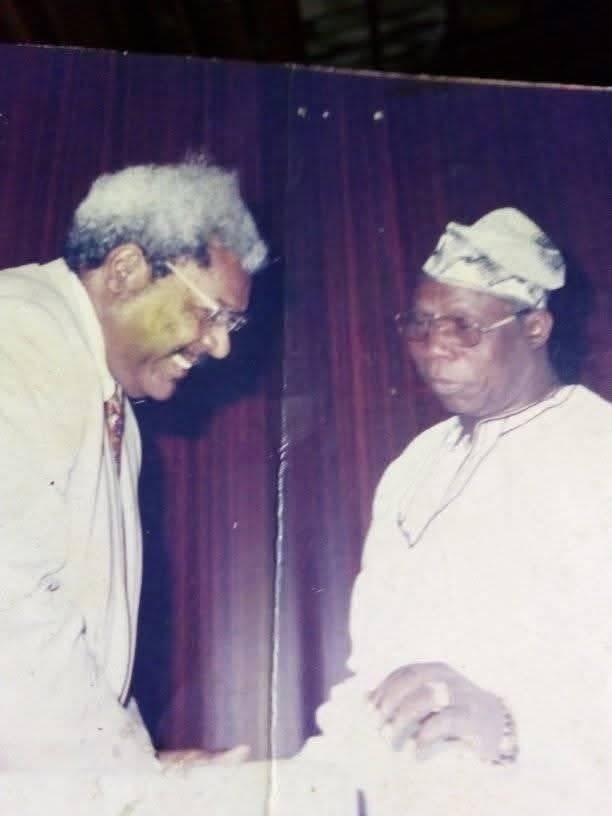
A historic meeting in Abuja between the legendary American boxing promoter and Nigeria’s former head of state.
The Meeting
In the year 2000, American boxing promoter Don King, renowned for promoting legendary fights and fighters such as Muhammad Ali and Mike Tyson, visited Chief Olusegun Obasanjo, former President of Nigeria, at the State House, Abuja.
The visit, documented by the now-defunct Concord Newspapers, was a courtesy call and symbolized the growing intersection of international sports, diplomacy, and Nigerian leadership.
Historical Context
Don King was at the peak of his influence in the boxing world, having promoted some of the most significant boxing matches in history.
Olusegun Obasanjo had returned to democratic rule in 1999 after previously serving as military head of state from 1976 to 1979. His administration sought to enhance Nigeria’s global visibility and foster relationships with influential global figures.
Such meetings were not just social visits; they often explored opportunities for sports development, business partnerships, and international collaboration.
Legacy
The photo of Don King and Obasanjo stands as a historical marker of Nigeria’s engagement with prominent global personalities at the turn of the millennium. It reflects the intersection of politics and international sports diplomacy, emphasizing Nigeria’s stature on the world stage at the time.
Source
Concord Newspapers (defunct), 2000







A glimpse into Nigeria’s automotive and economic history: Ford Escort MK I sold for ₦2,290 in 1974.
The Advertisement
In 1974, Nigerians could purchase a Ford Escort MK I saloon car for ₦2,290—a figure that today evokes surprise given the current cost of automobiles. The ad, published in the Daily Times, was designed to attract middle-class buyers looking for a reliable, modern vehicle.
The car was sold through J. Allen & Company Limited, a major automotive dealer at the time, known for importing and distributing popular foreign car brands to Nigeria’s growing urban centers.
Historical Context
The 1970s were a golden period for Nigeria’s economy, fueled by the oil boom. While cars were still a luxury for many, affordable models like the Ford Escort provided middle-class families access to personal transportation.
For perspective, ₦2,290 in 1974 would have had substantial purchasing power, allowing buyers to acquire a brand-new vehicle with modest financing options, which is almost unimaginable today given inflation and the high cost of imported cars.
Legacy
This vintage advertisement is more than just a marketing relic; it captures a snapshot of Nigeria’s economic and social life in the 1970s. It reflects a time when personal mobility was becoming increasingly attainable and illustrates the dramatic shift in prices and economic conditions in the decades that followed.
Today, such an ad serves as a reminder of the need for economic reforms and sustainable growth, prompting reflection on how far Nigeria has come—and how far it still needs to go.
Source
Daily Times, 1974
Columns
The 1947 Pan-African Federation Meeting in Manchester: Nigeria and Britain After World War II
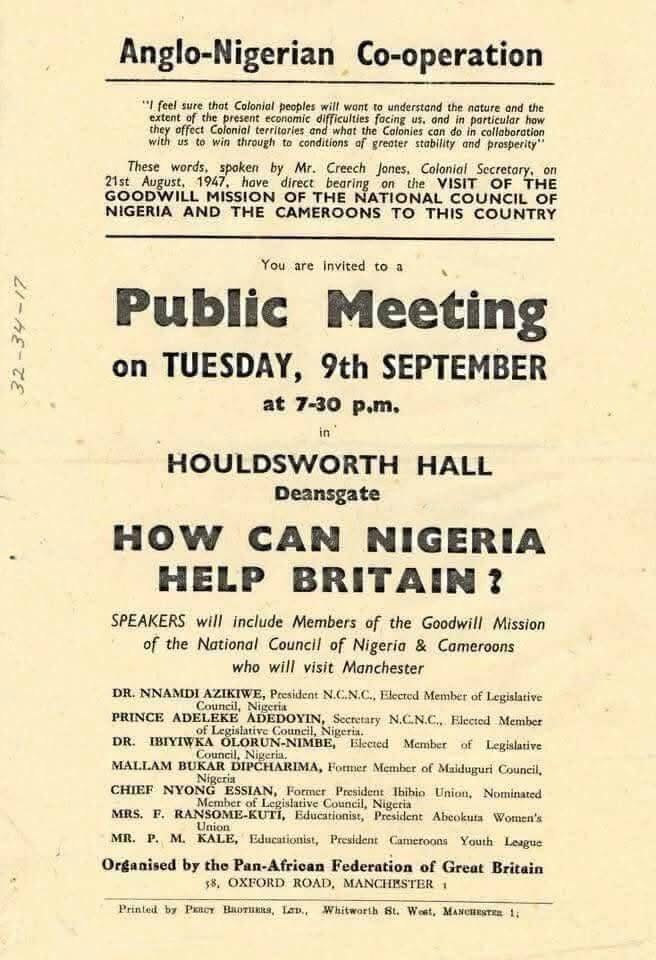
A historic gathering where Nigerian nationalist leaders discussed economic cooperation between Britain and Nigeria in the post-war era.
A Historic Announcement from 1947
The vintage poster advertises a public meeting organised by the Pan-African Federation in Manchester on Tuesday, 9 September 1947.
The event, titled “How Can Nigeria Help Britain?”, was scheduled to take place at Houldsworth Hall, located along Deansgate.
The meeting formed part of a broader discussion about Anglo-Nigerian economic cooperation at a time when Britain was struggling to rebuild its economy after the devastation of World War II.
Britain’s Post-War Economic Crisis
In the years following the war, Britain faced serious economic challenges. Industrial infrastructure had been damaged, foreign reserves were depleted, and the country was heavily indebted.
Colonies across the British Empire, including Nigeria, were viewed as important economic partners that could support Britain through:
export of agricultural products
supply of raw materials
expansion of trade within the empire
The 1947 meeting therefore addressed a critical question of the time: how Nigeria could contribute to Britain’s recovery while also advancing its own economic development.
The NCNC Goodwill Mission
The event featured members of the National Council of Nigeria and the Cameroons (NCNC), who were visiting Britain as part of a Goodwill Mission.
The NCNC had emerged as one of the most influential political movements in Nigeria during the 1940s. The organisation advocated for:
constitutional reforms
political representation for Nigerians
eventual self-government
By engaging with British audiences, Nigerian leaders sought to present their perspectives on economic cooperation and political progress.
Distinguished Speakers
Several prominent Nigerian political figures participated in the Manchester meeting.
Among them was Nnamdi Azikiwe, one of Nigeria’s most influential nationalist leaders and a future President of Nigeria. Azikiwe was a central figure in the NCNC and played a major role in the struggle for independence.
Other speakers included:
Adeleke Adedoyin, a prince from Ile-Ife and prominent businessman
Ibiyinka Olorun-Nimbe, a medical doctor and political activist
Bukar Dipcharima, a northern Nigerian political leader
Nyong Essien, a nationalist figure from southeastern Nigeria
Funmilayo Ransome-Kuti, renowned feminist activist and political organiser
P. M. Kale, another member of the NCNC delegation
The diversity of speakers reflected Nigeria’s emerging national political consciousness, bringing together voices from different regions and social backgrounds.
Pan-African Connections in Britain
The meeting was organised by the Pan-African Federation, an organisation that played a key role in linking African and Caribbean activists living in Britain.
Following the famous Fifth Pan-African Congress, Manchester had become an important centre for Pan-African political discussions.
These gatherings allowed African leaders, students, and intellectuals to:
discuss colonial policies
share strategies for political reform
build networks that would later influence independence movements across Africa.
Nigeria on the Path to Independence
By 1947, Nigeria was still under British colonial rule, but nationalist movements were becoming increasingly organised.
Events like the Manchester meeting were significant because they allowed Nigerian leaders to engage directly with British audiences while presenting arguments for:
economic partnership based on mutual benefit
greater political autonomy
recognition of Nigerian leadership in shaping the country’s future.
Within little more than a decade, Nigeria would move toward independence, which was achieved in 1960.
Historical Significance of the Poster
Today, the 1947 announcement poster serves as an important historical document.
It captures a moment when Nigerian nationalists were actively participating in global political discussions while negotiating their country’s relationship with the British Empire.
The poster also highlights the collaboration between Nigerian political leaders and Pan-African activists in Britain—connections that helped shape the broader African independence movements of the twentieth century.
Sources
Archives of the Pan-African Federation
Historical records of the National Council of Nigeria and the Cameroons Goodwill Mission
Studies on post-war British economic policy and colonial relations
Documentation of Nigerian nationalist activities in Manchester during the 1940s.
Columns
Augustine Azuka “Jay-Jay” Okocha is a legendary figure in the world of football, widely regarded as one of Africa’s greatest players and a master of flair, creativity, and sheer skill.
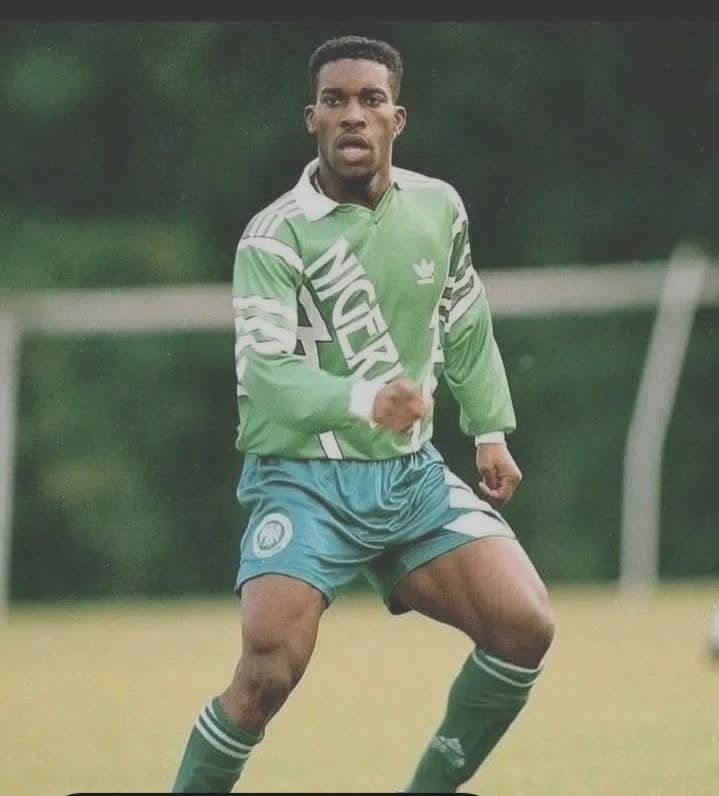
Born in Enugu, Nigeria, in 1973, Okocha mesmerized fans around the globe with his dazzling footwork, unpredictable dribbling, and joyous style of play that made football look effortless and fun.
A Midfield Maestro
Okocha played primarily as an attacking midfielder, where his ability to control the tempo of a match, deliver pin-point passes, and beat defenders with ease earned him global acclaim. His signature moves—stepovers, flicks, feints, and no-look passes—captivated audiences and often left opponents flat-footed. He wasn’t just a showman; he was a game-changer.
National Pride and Leadership
He was a longtime stalwart of the Nigerian national team, the Super Eagles, where he rose to the rank of captain. Okocha played a crucial role in some of Nigeria’s most memorable football moments, including their 1994 Africa Cup of Nations (AFCON) victory, the 1996 Olympic gold medal win, and Nigeria’s historic 1994 FIFA World Cup debut. His leadership on and off the pitch made him a beloved figure not only in Nigeria but across Africa.
Club Career Highlights
Jay-Jay Okocha had an illustrious club career across Europe. He played for several top clubs, including:
Eintracht Frankfurt in Germany, where he first gained international attention.
Paris Saint-Germain (PSG) in France, where he dazzled fans and shared the field with future stars like Ronaldinho.
Bolton Wanderers in the English Premier League, where he became a cult hero, even captaining the side and leading them to a League Cup final.
At every club he played for, Okocha was known not just for his talent but for his sportsmanship, charisma, and leadership.
Global Impact and Legacy
Okocha’s impact went far beyond Nigeria. He inspired a generation of African footballers and left an indelible mark on the global game. His style of play continues to influence young players who see football not just as competition, but as art in motion. His famous quote—”I’m so good they named me twice”—captures the confidence and charm that made him a fan favorite.
The image in question likely shows Okocha in action for Nigeria, with the “NIGERI” text visible on his jersey—a timeless representation of national pride, skill, and legacy.
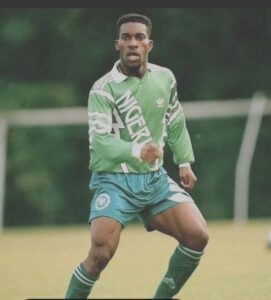
Jay-Jay Okocha remains a living legend, a footballer whose magic still echoes in highlight reels and in the hearts of fans around the world.

BREAKING: Senate Moves To Declare Abaribe’s Seat Vacant Over Defection

Vintage 1974 Ford Escort Advertisement in Nigeria

BREAKING: Nine senators from the PDP, LP, and APGA have defected to the ADC today in the Senate chambers.

-
Business1 year ago
US court acquits Air Peace boss, slams Mayfield $4000 fine
-

 Trending1 year ago
NYA demands release of ‘abducted’ Imo chairman, preaches good governance
-

 Politics1 year ago
Mexico’s new president causes concern just weeks before the US elections
-

 Politics1 year ago
Putin invites 20 world leaders
-

 Politics1 year ago
Russia bans imports of agro-products from Kazakhstan after refusal to join BRICS
-
Entertainment1 year ago
Bobrisky falls ill in police custody, rushed to hospital
-
Entertainment1 year ago
Bobrisky transferred from Immigration to FCID, spends night behind bars
-
Education2 years ago
GOVERNOR FUBARA APPOINTS COUNCIL MEMBERS FOR KEN SARO-WIWA POLYTECHNIC BORI