
Politics
Europe can defeat Russia in any conflict, EU leaders tell Zelensky

Europe is able to defeat Russia in any kind of conflict and will beat Vladimir Putin in his new arms race, Poland‘s Prime Minister reassured Volodymyr Zelensky as EU leaders gathered to meet the Ukrainian President for ‘watershed’ talks in Brussels.
‘Europe as a whole is truly capable of winning any military, financial, economic confrontation with Russia – we are simply stronger,’ Donald Tusk said ahead of the summit. ‘We just had to start believing in it. And today it seems to be happening.’
The Polish leader warned that Vladimir Putin had started ‘a new arms race’ that has left Europe with no choice but to prepare itself for war.
‘Europe must be ready for this race, and Russia will lose it like the Soviet Union 40 years ago,’ he wrote on X. ‘From today, Europe will arm itself more wisely and faster than Russia.’
His comments came as EU leaders hold a day of emergency talks in a bid to beef up their own security and ensure that Ukraine’s defence, as the allies face the prospect of being cut adrift by US President Donald Trump.
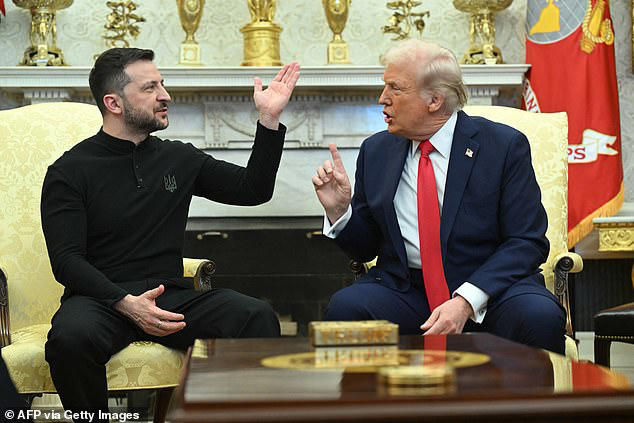
Zelensky has expressed his gratitude to EU leaders for standing by Ukraine’s side, with the summit less than a week after he attended an explosive meeting with Trump at the White House.
He received warm welcomes from most leaders at today’s gathering – a stark contrast with the verbal lashing the Ukrainian president got from Trump.
‘I want to thank all our European leaders,’ Zelensky said. ‘Strong support from the very beginning of the war. During all this period, and last week, you stayed with us.’
Since the Oval Office showdown, Washington has suspended the military aid and intelligence sharing that has helped Kyiv fight off Russia’s invasion.
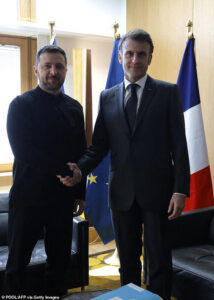
Ukraine’s President Volodymyr Zelensky (L) meets France’s President Emmanuel Macron on the sidelines of the Special European Council to discuss continued support for Ukraine
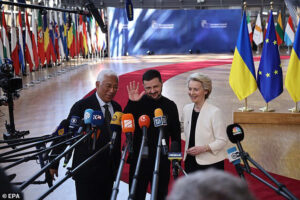
EU Council President Antonio Costa, Ukraine’s President Volodymyr Zelensky and European Commission President Ursula von der Leyen talk to the press as they arrive for an European Council meeting in Brussels
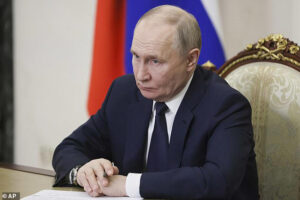
Russian President Vladimir Putin attends a cabinet meeting in Moscow, on March 5
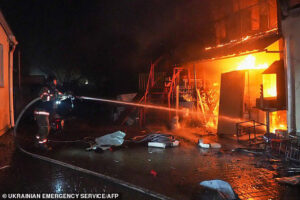
A Ukrainian rescuer works to extinguish a fire in a building following a Russian attack at an undisclosed location in Odesa region
Today’s crisis talks involving members of the 27-nation bloc come amid fears that the Trump administration is making huge concessions to Russia and freezing Ukraine out of negotiations to end the war.
Friedrich Merz, the likely next chancellor of Germany, and summit chairman Antonio Costa discussed over breakfast in Brussels ways to fortify Europe’s defenses on a short deadline.
Merz pushed plans this week to loosen the nation’s rules on running up debt to allow for higher defense spending.
Meanwhile, the EU was waking up to news that French President Emmanuel Macron would confer with EU leaders about the possibility of using France‘s nuclear deterrent to protect the continent from Russian threats.
It all underscored the sea change that has taken place in the two months since Trump took office and immediately started upending the cornerstones of cooperation between the United States and Europe that had been the bedrock of Western security since World War II.
‘Spend, spend, spend on defense and deterrence. That’s. the most important message,’ said Danish Prime Minister Mette Frederiksen.
The call is a sharp departure from decades of decline in military spending in Europe, where defense often came last in many budgetary considerations.
The bloc will ‘take decisive steps forward,’ Macron told the French nation Wednesday evening.
‘Member states will be able to increase their military spending’ and ‘massive joint funding will be provided to buy and produce some of the most innovative munitions, tanks, weapons and equipment in Europe,’ he said.
He added that ‘Europe’s future does not have to be decided in Washington or Moscow.’
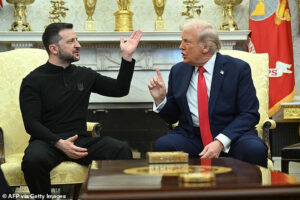
Zelensky is desperately trying to repair relations with Mr Trump after their extraordinary White House bust-up (pictured)
European Commission President Ursula von der Leyen has proposed a plan to loosen budget rules so countries that are willing can spend much more on defense. Her proposal is underpinned by 150 billion euros ($162 billion) worth of loans to buy priority military equipment.
Most of the increased defense spending would have to come from national budgets at a time when many countries are already overburdened with debt.
Part of von der Leyen’s plan includes measures to ensure struggling member states won’t be punished for going too deep in the red if the spending is earmarked for defense.
‘Europe faces a clear and present danger, and therefore Europe has to be able to protect itself, to defend itself,’ she said.
France is struggling to reduce an excessive annual budget deficit of 5 per cent of GDP, after running up its total debt burden to 112 per cent of GDP with spending on relief for businesses and consumers during the COVID-19 pandemic and the energy crisis that followed Russia’s invasion of Ukraine.
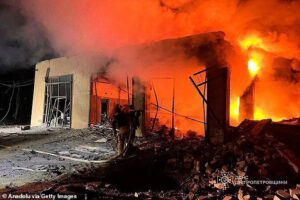
A view from the damaged site after the Russian missile strike on Kryvyi Rih
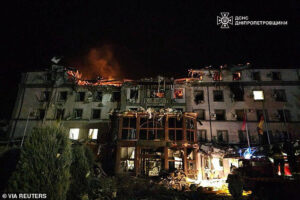
A fire burns in a destroyed building following a Russian missile strike, amid Russia’s attack on Ukraine, in Kryvyi Rih, Ukraine March 5, 2025
Five other countries using the euro currency have debt levels over 100% of GDP: Belgium, Greece, Spain, Italy and Portugal.
Europe’s largest economy, Germany, has more room to borrow, with a debt level of 62 per cent of GDP.
Part of any security plan is also to protect the increasingly beleaguered position of Ukraine.
A Russian missile killed four people staying at a hotel in Zelenskyy’s hometown overnight.
He said that a humanitarian organization’s volunteers had moved into the hotel in Kryvyi Rih, in central Ukraine, just before the strike.
The volunteers included Ukrainian, American and British nationals, but it wasn’t clear whether those people were among the 31 injured.
Early this week, Trump ordered a pause to US military supplies to Ukraine as he sought to press Zelenskyy to engage in negotiations to end the war with Russia, bringing fresh urgency to Thursday’s summit.
Thursday’s meeting is unlikely to address Ukraine’s most pressing needs. It is not aimed at urgently drumming up more arms and ammunition to fill any supply vacuum created by the US freeze. Nor will all nations agree to unblock the estimated 183 billion euros ($196 billion) in frozen Russian assets held in a Belgian clearing house, a pot of ready cash that could be seized.
Still, the Europeans underlined the importance of the moment.
‘This is a watershed moment for Europe and Ukraine as part of our European family. It’s also a watershed moment for Ukraine,’ von der Leyen said, as she stood alongside Zekenskyy before striding together into the summit.
But perhaps the biggest challenge for the EU will be taking a united stance at a moment when it’s fractured, since much of the bloc’s actions requires unanimous support. Hungary is threatening to veto part of the summit statement on Ukraine, as is Slovak Prime Minister Robert Fico.
‘We have to take decisions no matter the one or two which are opposing every time,’ said Lithuanian President Gitanas Nauseda. ‘Otherwise history will penalize us and we will pay a very high cost.’
Thursday’s summit is unlikely to produce immediate decisions on spending for Ukraine or its own defenses.
Another EU summit where the real contours of decisions would be much clearer is set for March 20-21.










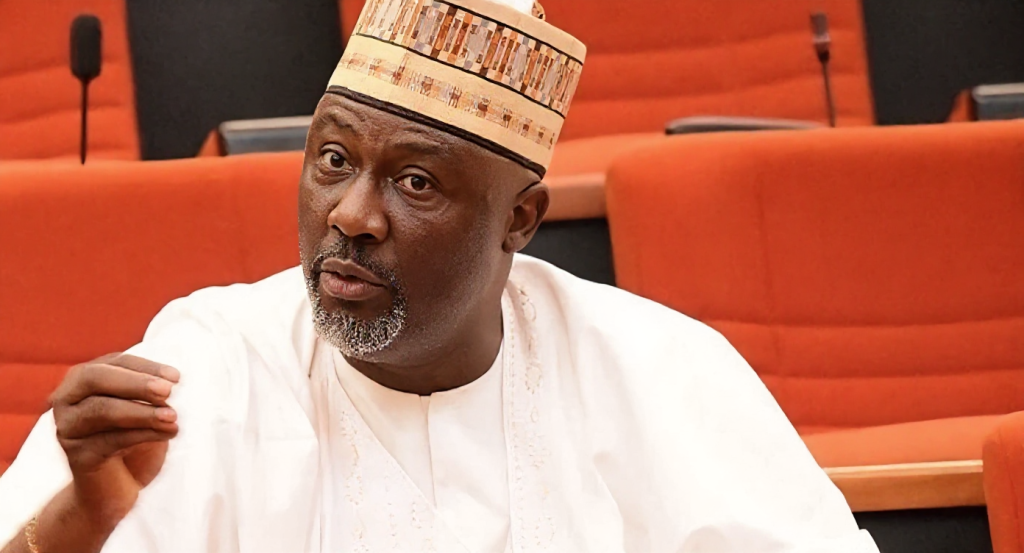
Former lawmaker, Dino Melaye Esq, has raised concerns over the Senate’s reported rejection of the electronic transmission of election results.
The move, according to Melaye, is a clear endorsement of election rigging and an indication of a sinister plan to rig the 2027 elections.
In a statement on Friday, the former lawmaker criticized the Senate’s decision, stating that it undermines the credibility of the electoral process.
The African Democratic Congress, ADC chieftain, also stated that the move opens the door for electoral manipulation and fraud.
He further warned that the rejection of electronic transmission of results is a step backwards for democracy in Nigeria.
Melaye called on lawmakers and citizens to stand up against “this blatant attempt to undermine the will of the people and ensure that future elections are free, fair, and transparent”.
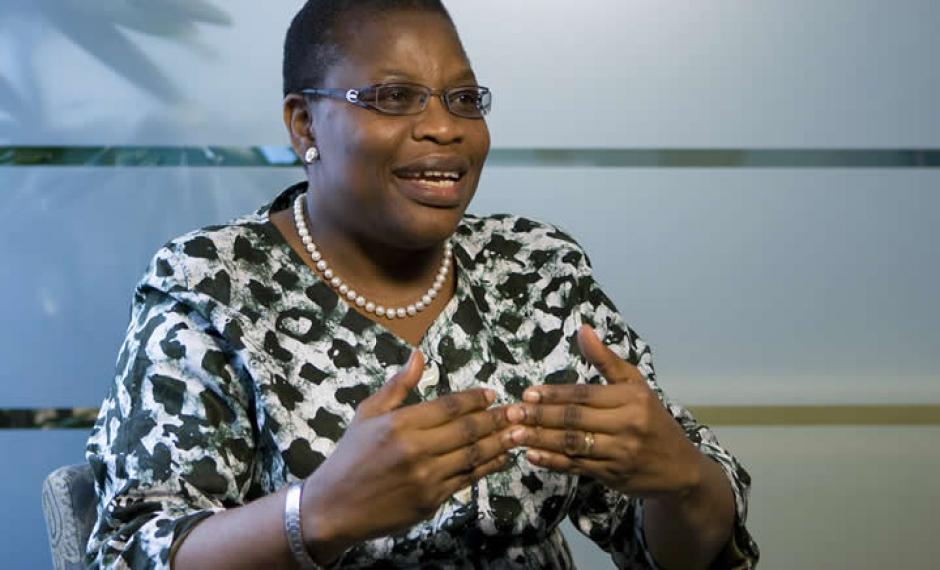
Former Minister of Education, Oby Ezekwesili, has said Nigerians have every reason to be mad at the Senate over the ongoing debate on e-transmission of election results.
Ezekwesili made this known on Friday when she featured in an interview on Arise Television’s ‘Morning Show’ monitored by DAILY POST.
DAILY POST reports that the Senate on Wednesday turned down a proposed change to Clause 60, Subsection 3, of the Electoral Amendment Bill that aimed to compel the electronic transmission of election results.
Reacting to the matter, Ezekwesili said, “The fundamental issue with the review of the Electoral Act is that the Senate retained the INEC 2022 Act, Section 60 Sub 5.
“This section became infamous for the loophole it provided INEC, causing Nigerians to lose trust. Since the law established that it wasn’t mandatory for INEC to transmit electoral results in real-time, there wasn’t much anyone could say.
“Citizens embraced the opportunity to reform the INEC Act, aiming to address ambiguity and discretionary opportunities for INEC. Yet, the Senate handled it with a “let sleeping dogs lie” approach. The citizens have every reason to be as outraged as they currently are.”
Politics
Electoral act: Senate’s action confirms Nigeria ‘fantastically corrupt’, ‘disgraced’ – Peter Obi
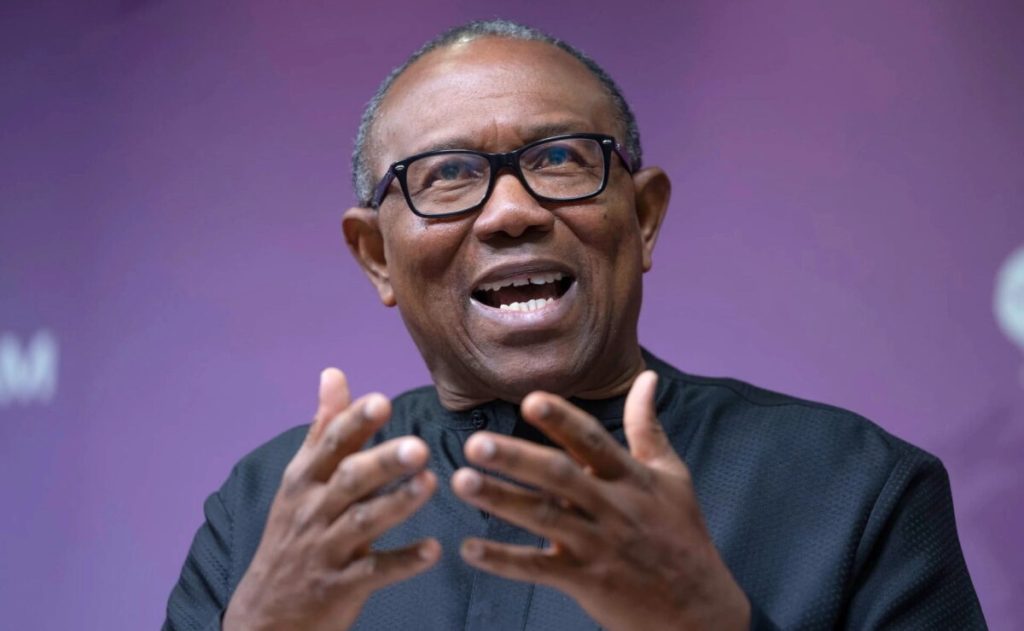
Former Labour Party presidential candidate, Peter Obi, has condemned the Senate’s refusal to make electronic transmission of election results mandatory, saying the move further exposes Nigeria as a fantastically corrupt and disgraced country.
Obi expressed his views in a statement shared on X on Friday, where he accused lawmakers of deliberately weakening Nigeria’s democratic process ahead of the 2027 general elections.
He explained that his reaction came after a brief pause to mourn victims of a deadly tragedy in Kwara State, where over 150 people reportedly lost their lives.
“Let us first pray for the souls of the innocent Nigerians lost in Kwara. That painful incident is why I delayed responding to the shameful development surrounding our electoral system,” he wrote.
Describing the Senate’s decision as intentional and dangerous, Obi said rejecting mandatory electronic transmission was not a simple oversight but a calculated attempt to block transparency.
“The Senate’s open rejection of electronic transmission of results is an unforgivable act of electoral manipulation ahead of 2027,” he said.
According to him, the action strikes at the heart of democracy and raises serious questions about the true purpose of governance in Nigeria.
“This failure to pass a clear safeguard is a direct attack on our democracy. By refusing these transparency measures, the foundation of credible elections is being destroyed. One must ask whether government exists to ensure justice and order or to deliberately create chaos for the benefit of a few.”
The former Anambra State governor linked the post-election controversies of the 2023 general elections to the failure to fully deploy electronic transmission of results, insisting that Nigerians were misled with claims of technical failures.
“
The confusion, disputes and manipulation that followed the 2023 elections were largely due to the refusal to fully implement electronic transmission,” he said.
He added that the so-called system glitch never truly existed.
Obi compared Nigeria’s electoral process with those of other African countries that have embraced technology to improve credibility, lamenting that Nigeria continues to fall behind.
“Many African nations now use electronic transmission to strengthen their democracy. Yet Nigeria, which calls itself the giant of Africa, is moving backwards and dragging the continent along.”
He criticised Nigeria’s leadership class, saying the country’s problems persist not because of a lack of ideas but because of deliberate resistance to meaningful reform.
“We keep organising conferences and writing policy papers about Nigeria’s challenges. But the truth is that the leaders and elite are the real problem. Our refusal to change is pushing the nation backwards into a primitive system of governance.”
Warning of the dangers ahead, Obi said rejecting electronic transmission creates room for confusion and disorder that only serves the interests of a small group.
He also recalled past remarks by foreign leaders who described Nigeria as corrupt, arguing that actions like this continue to justify those statements.
“When a former UK Prime Minister described Nigeria as ‘fantastically corrupt,’ we were offended. When former US President Donald Trump called us a ‘disgraced nation,’ we were angry. But our continued resistance to transparency keeps proving them right.”
Obi warned that Nigerians should not accept a repeat of the electoral irregularities witnessed in 2023.
“Let there be no mistake. The criminality seen in 2023 must not be tolerated in 2027.”
He urged citizens to be ready to defend democracy through lawful and decisive means, while also calling on the international community to closely monitor developments in Nigeria’s electoral process.
“The international community must pay attention to the groundwork being laid for future electoral manipulation, which threatens our democracy and development,” Obi stated.
He concluded by expressing hope that change is still possible if Nigerians take collective responsibility.
“A new Nigeria is possible but only if we all rise and fight for it.”

Police bust syndicate behind nude photo blackmail in Lagos

Man in shock after lady he lodged with in a hotel in Abuja flees with his car and other valuables

US Reacts As De@th Toll In Kwara Terror Attacks Hits 200

-
Business1 year ago
US court acquits Air Peace boss, slams Mayfield $4000 fine
-

 Trending1 year ago
NYA demands release of ‘abducted’ Imo chairman, preaches good governance
-

 Politics1 year ago
Mexico’s new president causes concern just weeks before the US elections
-

 Politics1 year ago
Putin invites 20 world leaders
-

 Politics1 year ago
Russia bans imports of agro-products from Kazakhstan after refusal to join BRICS
-
Entertainment1 year ago
Bobrisky falls ill in police custody, rushed to hospital
-
Entertainment1 year ago
Bobrisky transferred from Immigration to FCID, spends night behind bars
-
Education1 year ago
GOVERNOR FUBARA APPOINTS COUNCIL MEMBERS FOR KEN SARO-WIWA POLYTECHNIC BORI