
Politics
FG approves N1.8tn road projects, new contracts

The Federal Executive Council on Monday approved the rescoping of old highway contracts and new reads worth about N1.81tn, consisting of N760.4bn in naira-denominated projects with a separate $651.7m (N1.05tn) facility for the 7th Axial Road linking the Lekki Deep‑Sea Port to Sagamu‑Ore.
This also includes the Aba‑Ikot‑Ekpene Road, whose first phase was ratified at N30.23bn alongside nine other corridors spread across 12 states.
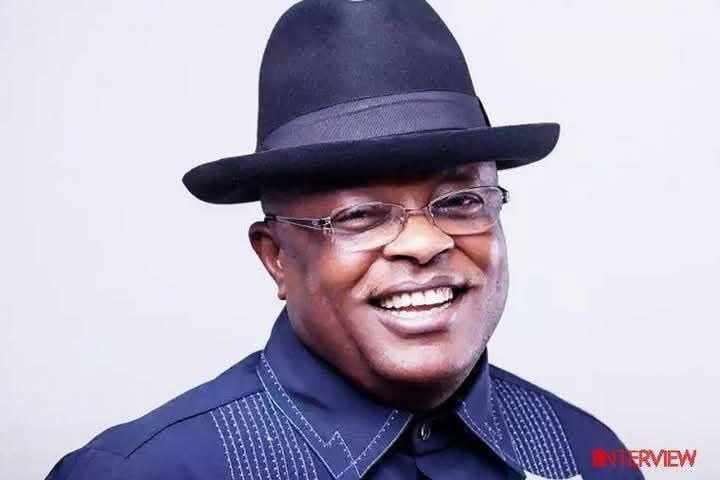
The Minister of Works, Dave Umahi, revealed this to State House Correspondents at the end of the 25th meeting of the Federal Executive Council under the Bola Tinubu administration, at the Aso Rock Villa, Abuja.
Umahi said, “FEC approved the rescoping of a project that is within Ondo State and Ekiti State and approved that the fund available be used to do 15 kilometres of the 18.438 kilometres dualised,” adding that the Akure-Ado‑Ekiti dualisation will now cost N19.407bn for the trimmed 15-kilometre stretch.
He noted that similar variations have reduced the Sokoto-Zamfara-Katsina-Kaduna corridor to 82.4 kilometres plus six bridges for the same N105bn originally budgeted.
Umahi explained, “FEC approved the rescoping of a project that is within Ondo State and Ekiti State and approved that the funds available be used to do 15 kilometres of the 18.438 kilometres dualised. And so, the FEC had earlier approved that we should be able to rescope all the inherited projects within the available funds. So we say that 15 kilometer is been rescoped for a contract sum of N19.407bn and that is rescoping/variation of dualisation of Akure-Eta-Ogburu-Ijo-Ekiti border to Ikere-Ado-Ekiti section one, and that is in Ekiti state, and spanning to Ondo State. That was approved.
“The second approval came from the rescoping and variation of the Sokoto road that goes to Zamfara, Katsina and Kaduna. It is a total of 375 kilometres dualised, and we inherited it even though it was awarded at the twilight of the last administration. It was divided into four sections.
“The first section, being done by SKCC starting from Sokoto to Zamfara, is being done on reinforced concrete. The second section is done in Zamfara axis, and is being done by Setraco, and that’s the section that was originally awarded.
“The old section was 175 kilometer, and it was awarded for N105bn and so, in line with FEC approval, we had to review the contract, but within the available funds in NNPC, which is N105bn, so we rescoped it to 82.4 kilometer plus six bridges for the same contract sum of N105bn.”
Meanwhile, the Maiduguri-Mongonu Road will be constructed “30 kilometres at a time,” starting with N21bn for the first phase.
“We also have a similar situation of a project that was awarded, you know, it is Maiduguri to Mongonu Road in Borno State, and it was awarded on July 3, 2018, 105 kilometres for 21.729 kilometres, and in line with FEC directives, we had to reduce the amount into two phases.
“Phase one is 30 kilometres, and that is for a contract sum of N21bn for 30 kilometres. The second phase is going to come as soon as this first section is completed, and then it will be brought before FEC,” he said.
On the Aba-Ikot-Ekpene Road, he explained, “The memo was not circulated earlier. Today, it was circulated and ratified for a total sum of N30.23bn. That’s phase one. In the same category of ratification was the rehabilitation of Ebute-Ero Outer Marina Shoreline, which was awarded N114bn before to build weld equipment plant company, and today it’s been reviewed to a total sum of N176.495bn, because we had a number of infrastructure along the coast that was being eroded, like the military base, the Marine and Navy base were being eroded. And so it became an emergency situation.”
The minister also listed fresh approvals for the Ebonyi Abakaliki–Afikpo flyover at N25bn, Ikoga–Atan–Ado‑Odo Road in Ogun at N37.045bn, a N150bn rescope of the Enugu–Onitsha Road now partly funded by the MTN tax credit, and N187bn to finish the remaining 96 kilometres of the Benin–Shagamu–Ore highway.
“So we also have four projects that were awarded by the Federal Executive Council. The first one is in Ebony state, Abakali-Afikpo fly over. It was awarded for N25bn. There is a second section, another one within this lot. It is the construction of Ikoga Road and Atan-Alapoti-Ado-Odo Road in Ogun state, and that is awarded for a contract sum of N37.045bn
“Then you have the rescoped section of Enugu-Onitsha Road, 77 kilometres, which is awarded for N150bn. The ongoing Enugu-Onitsha Road, which is partly being done by MTN under tax credit. And lastly, under this is the Benin-Shagamu-Ore Road. Recall that we had taken off from the Sagamu exchange.
“Then we took off 12 kilometres by 24 kilometres. So the remaining one is 48 kilometres by two. That’s 96 kilometres, and that’s what has been awarded today for N187bn for CBC,” he further explained.
According to Umahi, the shoreline at Ebute‑Ero/Outer Marina in Lagos will also be rebuilt for N176.495bn to arrest “severe coastal erosion threatening military and naval bases.”
He said the council also cleared the Ebute‑Ero Outer Marina shoreline rehabilitation at N176.495bn, the Benin–Shagamu–Ore dualisation (96 km) for N187bn, the Enugu–Onitsha Road rescope for N150bn, and the Abakaliki–Afikpo fly‑over and Ikoga–Atan–Ado‑Odo Road for N25bn and N37.045bn respectively.
“Today, it was circulated and ratified for a total sum of N30.23bn,” he added of the Aba‑Ikot‑Ekpene approval, stressing that each award follows the Council’s instruction to match available funds.
On the 7th Axial Road—from Lekki Port through Epe to Sagamu‑Ore—Umahi stressed its strategic value to Dangote Refinery, the fertiliser plant and Lagos export zones.
“It takes us from the lake deep-sea port, evacuating the goods of the Dangote refinery, Dangote fertiliser and other goods of the deep-sea port. And it takes us straight to Ekpe and then to the Shagamu-Ore, which is an exit to the 17 Southern states and the other northern states within that axis. And so it’s been approved for a total of $651.7m,” he said, indicating that the Federal Government secured financing from the China Exim Bank after President Tinubu’s pitch in Beijing last year.
“And when we were in China, Mr. President presented to the President of China two projects, the Akwanga-Jos-Bauchi-Gombe Road, and then this 7th Axial Road for funding of China Exim Bank. And so the project is 50 kilometres, with five kilometres of bridges. And it’s an evacuation corridor.
“The last one was in Gombe, the rehabilitation of the Chamnuman section of Gombe-Yola Road in Adamawa state, which has been rescoped into phases and awarded N9.253bn to CGC for the first phase,” the Minister announced.
Umahi also announced that more than 70 per cent of Section 1 of the Lagos–Calabar coastal highway is done, 10 km of the Sokoto–Badagry concrete stretch at Kebbi “will be ready for commissioning by May 25,” and international lenders have praised the procurement as excellent and even “undervalued.”
“30 kilometres is going to be made available for Mr. President to commission. And another 10 kilometres is going to be made available for section two.
“I’m excited to announce that the Dutch bank and the Development Bank of Southern Africa were reviewing the loan component of that project. And they reviewed all the bid documents.
“For them to give you money, you have to pass through the eye of a needle. They came up with a verdict that the procurement was excellent. In fact, they said that it was undervalued,” he explained.
Meanwhile, the Permanent Secretary, Cabinet Affairs Office, Dr. Emanso Umobong, announced ecological remediation projects, which saw the council approve N26.35bn for urgent works on three ageing dams within the Kano River Irrigation Project.
Umobong said, “Today at the federal executive council meeting, the memorandum on ecological projects was approved. You may be aware that some of the dams were constructed as far back as 1974.
“So, three contracts were awarded. One is the rehabilitation and expansion of Tiga Dam in the Kano River Irrigation project. This is awarded to MSSRS Masaki Limited at the cost of N11.84bn.
“The second is the rehabilitation and expansion of the irrigation scheme of the Shalangwa Gorge Dam, which UYK Nigeria Limited has been awarded at a cost of N7.47bn. The last is the rehabilitation of the Kafin Chiri irrigation project, which has been awarded at a cost of N7.04bn.”
She explained that the projects were necessary for ecological remediation to sustain structural integrity and prevent flooding.
“This intervention will positively impact 30,000 farm families, 50,000 acres of arable agricultural land, and it will enable three annual farming cycles through irrigation, and this will also generate over 300,000 jobs,” the Permanent Secretary said, listing erosion control, watershed management across 16 Kano local governments and full ecological rehabilitation among the deliverables.
In a related move, the council also authorised fresh works on Alau Dam near Maiduguri, whose breakdown led to devastating floods last September.



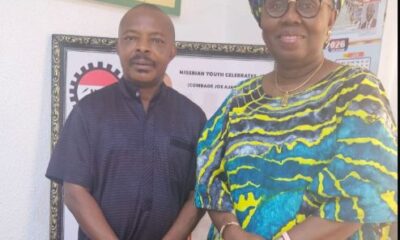


A Rivers State politician, Blessing Fubara, has declared his intention to contest the 2027 governorship election in Rivers State under the platform of the Nigeria Democratic Congress.
The politician has already obtained both the nomination and expression of interest forms needed to participate in the governorship race ahead of the 2027 election.
Blessing Fubara shares the same surname and local government area with the current Rivers State Governor, Siminalayi Fubara.
Both men are from Opobo/Nkoro Local Government Area. However, there has been no confirmation that they are family members.
The Chairman of the NDC in Rivers State, Success Jack, confirmed that Blessing Fubara is among those seeking the party’s governorship ticket.
He also stated that he could not confirm whether the governorship aspirant is related to Governor Siminalayi Fubara.
According to him, the party is preparing seriously for the 2027 general elections and hopes to win not only the governorship seat but other elective positions in Rivers State.
The development comes weeks after Blessing Fubara left the All Progressives Congress and joined the NDC.
Following his defection in Abuja, he was received by former Bayelsa State Governor, Seriake Dickson, alongside other leaders and members of the party.
After joining the NDC, Blessing Fubara said his decision was taken for the interest of Rivers people.
He also stated that the future of the state must be protected ahead of the next general election, expressing confidence that the state would experience positive changes after the 2027 polls.
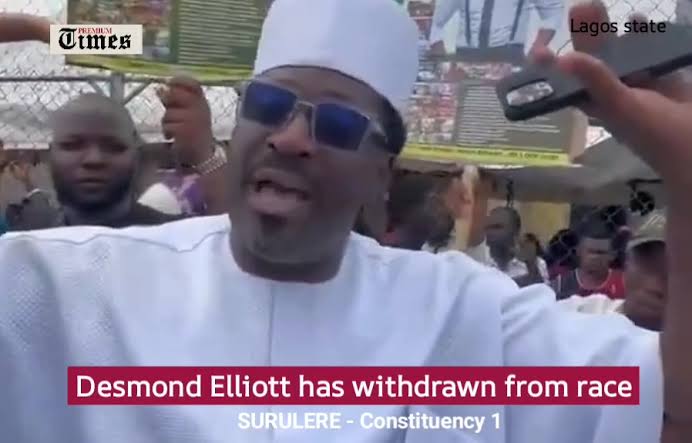
Surulere I lawmaker Desmond Elliot has withdrawn from the All Progressives Congress Lagos House of Assembly primaries, citing intimidation across multiple zones.
In a viral video posted online, the lawmaker said he was stepping out of the race despite seeking re-election under the APC. He alleged that his supporters faced intimidation during the process in several parts of the constituency.
Elliot’s decision came as the primaries held across Lagos on Tuesday. Chief of Staff to the President Femi Gbajabiamila, who represents Surulere Federal Constituency, praised the conduct of the exercise in Surulere, describing it as peaceful.
The withdrawal narrows the contest for the APC ticket in Surulere I ahead of the 2027 general election. Party officials in Lagos have not yet responded to Elliot’s claims, and the APC state chapter has not announced whether the primary in the constituency will proceed with other aspirants.
Elliot has represented Surulere I in the Lagos State House of Assembly since 2015.
https://www.instagram.com/reel/DYkCaAiMxxt/?igsh=ZWw5czl6MHJhNnRy
Politics
Political Shockwave in Rivers as Fubara Pulls Out of APC Governorship Race, Backs Party’s Candidate
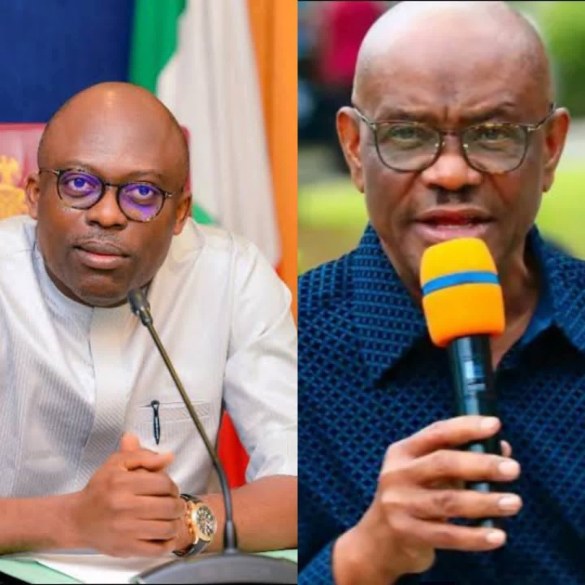
Rivers State Governor, Siminalayi Fubara, has officially withdrawn from the All Progressives Congress (APC) governorship primaries scheduled to take place on Thursday, a development that has stirred fresh political conversations across the state.
The governor announced his decision in a personally signed statement titled “My Decision to Withdraw from the Rivers State Gubernatorial Primaries,” which was released on Wednesday night.
In the statement, Fubara explained that his withdrawal followed wide consultations with political associates, stakeholders, and supporters. He stated that the decision was taken in the overall interest of peace, unity, and stability within the APC and Rivers State at large.
According to the governor, politics should not be allowed to divide the people or create unnecessary tension within the party. He stressed that preserving unity among party members and maintaining stability in the state remain more important than personal political ambition.
Fubara further pledged his total loyalty and support to whoever eventually emerges as the APC governorship candidate, assuring party faithful that he remains committed to the success and progress of the party ahead of the next general elections.
The Rivers governor also appreciated his supporters across the state for standing by him throughout the political process. He thanked party leaders, youth groups, women supporters, and political associates who had continued to show him solidarity and encouragement.
He urged his supporters not to see his withdrawal as the end of his political journey, but rather as a decision made in the collective interest of the party and the state. He also appealed to them to remain peaceful, united, and committed to the ideals of the APC.
Political observers have described the development as one of the biggest political surprises in Rivers State in recent times, especially considering the growing speculations and intense political alignments ahead of the governorship primaries.
Analysts believe the governor’s withdrawal may reshape the political calculations within the APC and influence the direction of the party’s governorship race moving forward.
The announcement has continued to generate mixed reactions from political stakeholders and residents across Rivers State. While some supporters described the move as strategic and mature, others expressed surprise over the governor’s sudden exit from the contest.
Several party faithful, however, commended Fubara for placing party unity and stability above personal ambition, noting that his decision may help reduce internal tensions and strengthen the APC ahead of the elections.
The development has also intensified attention on the remaining aspirants contesting for the APC governorship ticket, as consultations and political meetings continue ahead of the primary election.
Many observers believe the governor’s endorsement of the eventual APC candidate could play a major role in shaping the outcome of the party’s governorship battle and future political structure in the state.
As political activities continue to gather momentum in Rivers State, all eyes are now on the APC primaries and the next phase of political developments expected to unfold in the coming days.

Fubara To Contest Rivers Governorship Seat Under NDC

Breaking: Tinubu Appoints 39 Year Old Professor As New Jamb Registrar

Desmond Elliot Withdraws from APC Lagos Assembly Primaries, Cites Intimidation

-
Business2 years ago
US court acquits Air Peace boss, slams Mayfield $4000 fine
-

 Trending2 years ago
NYA demands release of ‘abducted’ Imo chairman, preaches good governance
-

 Politics2 years ago
Mexico’s new president causes concern just weeks before the US elections
-

 Politics2 years ago
Putin invites 20 world leaders
-

 Politics2 years ago
Russia bans imports of agro-products from Kazakhstan after refusal to join BRICS
-
Entertainment2 years ago
Bobrisky falls ill in police custody, rushed to hospital
-
Entertainment2 years ago
Bobrisky transferred from Immigration to FCID, spends night behind bars
-
Education2 years ago
GOVERNOR FUBARA APPOINTS COUNCIL MEMBERS FOR KEN SARO-WIWA POLYTECHNIC BORI