The surge in the mystery hPMV virus in the UK is mostly affecting young children — who are among the most vulnerable to serious complications, official data suggests.
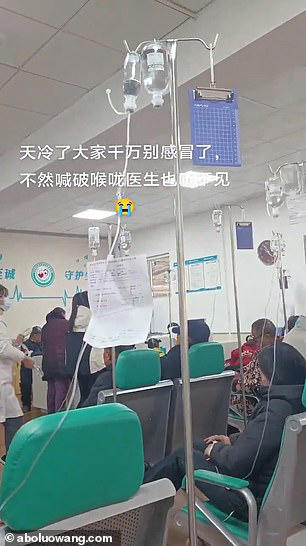
The infection has sparked concern over the last week after reports surfaced showing hospitals in China seemingly becoming overwhelmed by an outbreak of hPMV.
Now, new figures show intriguing details of the simultaneous rise in the UK — which has seen cases double in just a month.
This is more than double the proportion of very young children that tested positive for hMPV in late November.
It comes as the NHS is already buckling under a tidal wave of flu with cases quadrupling in a month.
Official data shows some 5,000 beds in the health service were being taken up by flu patients as of the end of the year with the virus forming a ‘quademic’ of winter viruses heaping pressure on NHS services alongside noroviruses, RSV and Covid.
Experts also said they expect ‘things to get worse before they get better’ given recent cold weather more people have socialised indoors over the Christmas and the New Year period.
While hMPV mostly causes a mild illness that is similar to the common cold, very young children, alongside the elderly and those weakened immune systems like cancer patients, are at increased risk of severe illness.
This includes serious and potentially fatal respiratory complications like pneumonia.
Symptoms of an hMPV infection are similar to the common cold or flu, such as a cough, runny or blocked nose, sore throat and fever, with those struck by it usually ill for about five days.
hMPV spreads through tiny droplets that are expelled by the infected when they breath, but to a far greater extent when they cough and sneeze.
Infection can occur when people close by breath in these droplets or by touching surfaces contaminated with them, like door handles, and then going on to touch their face or mouth.
People with hMPV can also spread the virus while suffering no symptoms themselves as they are still contagious before they begin to feel ill.
It’s for this reason that all Brits are being urged to practise good hand hygiene like regularly and properly washing their hands, stay in well-ventilated spaces and try to avoid others when ill to reduce the potential spread of hMPV.
A lack of good hand hygiene, not covering mouths when coughing or sneezing and a habit of putting objects or hands in their mouths means young children run a higher risk of being exposed to respiratory droplets that can spread viruses like hMPV.
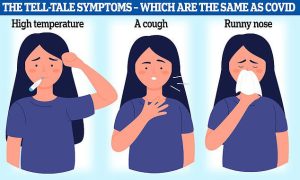
Experts have cautioned that hMPV, which produces flu-like symptoms, can lurk in the body for days and so it can be easily passed on to others
Playgroups where children mingle and interact can also provide fertile avenues for virus transmission as toddlers often cough or sneeze freely while and touching communal objects.
Children and babies are considered more vulnerable to a host of respiratory infections spread by droplets, like hMPV, because their immune systems are still developing.
Additionally, as the airways and lungs of very young children are very small, viruses that impede how we breathe can penetrate further, increasing the risk of complications.
China’s outbreak of hMPV, which has led to concerning footage of packed emergency rooms, has mainly spread amongst children.
Professor John Tregoning, an expert in vaccine immunology at Imperial College London, said when hMPV infects children it looks similar to respiratory syncytial virus (RSV), a common winter bug that usually causes mild, cold-like symptoms.
‘It is part of the cocktail of winter viruses that we are exposed to and, like other viruses, it will transmit in coughs, sneezes and in droplets,’ he said.
‘Protecting yourself by being in well-ventilated spaces, covering your mouth when you cough and washing your hands will all help,’ said Professor Tregoning
Similar to the advice related to Covid and RSV, those infected must ‘rest, stay hydrated and try not to spread it to others’, he added.
Professor Jaya Dantas, an expert in international health at Curtin University in Australia added: ‘In young children, the elderly and those who are immune compromised, hMPV can lead to severe cases and can move to the lower respiratory tract and may lead to pneumonia.’
Other experts however cautioned that the rise in cases in the UK ‘is not something that should cause undue concern’ and complications in children are rare.
Professor Jonathan Ball, a virologist at Liverpool School of Tropical Medicine, said: ‘hPMV has been known about since 2001, and has been circulating in humans for at least 50 years – probably a lot longer.
‘Unfortunately, it is associated with pneumonia, particularly in young children, but this is thankfully rare.’
Professor Paul Hunter, an expert in infectious diseases at the University of East Anglia, also told MailOnline: ‘Almost every child will have at least one infection with hMPV by their fifth birthday and we can expect to go on to have multiple reinfections throughout life.
‘It is one of the leading viral causes of respiratory infections in children under five-year-olds.’
Unlike Covid or the flu, there is no vaccine for hMPV.
Treatment primarily involves managing symptoms and supporting a patient as their body fights off the infection.

Huge numbers of patients appear to overwhelm a hospital in China. Photo taken from social media
Patients with drips attached at a hospital in China. Photo taken from social media
Dr Conall Watson, consultant epidemiologist at UKHSA, said hMPV levels usually peak in Britain this time of year and data suggest the current spread is in line within expected thresholds.
He added: ‘As with all respiratory viruses, you can help reduce infections being passed on through regular handwashing and catching coughs and sneezes in tissues and throwing them away.
‘If you have symptoms such as a high temperature, cough and feeling tired and achy, try to limit your contact with others, especially those who are vulnerable.
‘There are many viruses in circulation at the moment, including flu – if you have symptoms of a respiratory illness and you need to go out, our advice continues to be that you should consider wearing a face mask.’
Health officials in Beijing have downplayed the developments in their hospitals as an annual winter occurrence.
But the Chinese Center for Disease Control and Prevention has warned that rates of multiple flu-like illnesses are on the rise.
In its latest report, for the week to December 29, data suggested that 7.2 per cent of outpatient visits to local hospitals in northern provinces were due to a flu-like illness.
This was up 12 per cent on the previous week, and above the levels seen for the same week every fluseason since 2021.
Data for the southern part of the country suggested that 5.7 per cent of outpatient visits were due to flu-like illness.
This was up 21 per cent on the previous week, and also above the levels for the same week in 2021 when the figure was 4.1 per cent.
It was, however, below the levels in 2022 and 2023.
Some British virus experts have called on Chinese authorities to disclose vital information about its hMPV outbreak.
The UK authorities ‘need more information on the specific strain circulating’ in order to accurately assess the threat to the British public, warned virus expert Dr Andrew Catchpole.
‘hMPV is usually detected in the winter periods but it does seem that the rates of serious infection may be higher in China than what we would expect in a normal year,’ said Dr Catchpole, who is Chief Scientific Officer at infectious disease testing firm hVIVO.
‘We need more information on the specific strain that is circulating to start to understand if this is the usual circulating strains or if the virus causing high infection rates in China has some differences.’
He added: ‘It is unclear just how high the numbers are or if issues are arising purely due to coinciding with high flu and Covid levels.’
Promisingly, Dr Catchpole noted that while hMPV ‘does mutate and change over time with new strains emerging’, it is ‘not a virus considered to have pandemic potential’.
Read more