
Politics
The Proposed Drafted Bill for Regional Government in Nigeria

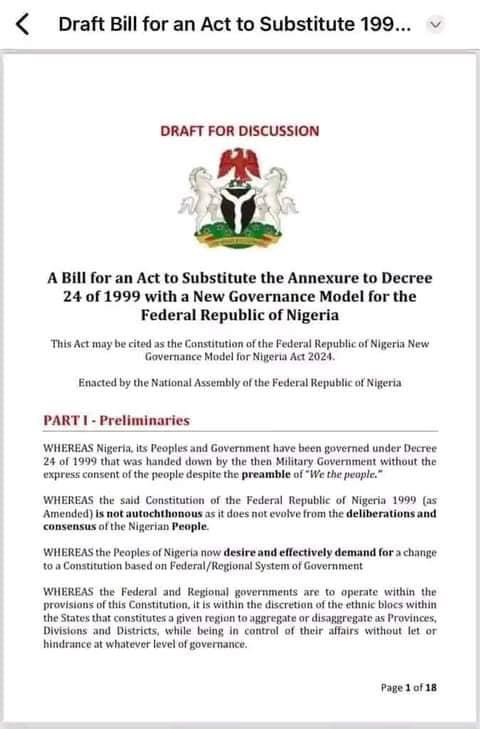
The Proposed Drafted Bill for Regional Government in Nigeria
Introduction
Nigeria, a country with diverse ethnic groups and cultures, has been struggling with issues of governance since gaining independence in 1960. With a federal system of government put in place by the 1999 Constitution, there have been debates on the effectiveness of this system in accommodating the needs and aspirations of the various regions in the country. In light of this, a proposed drafted bill for regional government is being considered as a means of addressing these challenges and promoting better governance in Nigeria.
Proposed Drafted Bill
The proposed drafted bill for regional government in Nigeria seeks to decentralize power and resources to the various regions in the country, thereby allowing them to have more control over their affairs. This bill would allow for the establishment of regional governments with elected officials who would be responsible for the administration of their respective regions. The regions would have the power to make decisions on issues such as economic development, infrastructure, education, and healthcare, among others.
The bill also seeks to address the issue of resource control in Nigeria, with the regions having more control over their natural resources and revenues. This would help to reduce the over-dependence on the federal government for funding and resources, and promote greater accountability and transparency in the management of resources.
Furthermore, the bill proposes the establishment of regional assemblies with legislative powers to enact laws and policies that are specific to the needs of the region. This would allow for a more responsive and efficient government that can address the unique challenges and priorities of each region.
Review of the 1999 Constitution
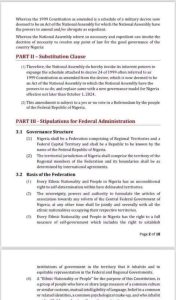
In order for the proposed drafted bill for regional government to be implemented, there would need to be amendments to the 1999 Constitution of Nigeria. These amendments would have to be passed by the National Assembly and approved by a majority of the states in the country before they can take effect. The amendments would include provisions for the establishment of regional governments, the devolution of powers to the regions, and the redistribution of resources and revenues.
The review of the 1999 Constitution would also need to address issues of federalism, resource control, and the distribution of wealth and resources in the country. This would require a thorough and comprehensive review of the existing constitutional provisions and an inclusive and transparent process that involves all stakeholders in the country.
Effective Date
The proposed drafted bill for regional government and the review of the 1999 Constitution amendments would take effect from 1st October. This date holds significance as it marks Nigeria’s independence day and symbolizes the country’s commitment to building a more inclusive and equitable society.
Conclusion
In conclusion, the proposed drafted bill for regional government in Nigeria presents an opportunity to address the challenges of governance and promote better representation and accountability at the regional level. By devolving powers and resources to the regions, the bill aims to promote greater autonomy and self-determination, and foster economic development and social cohesion in Nigeria. The review of the 1999 Constitution amendments is a crucial step in this process, and it is essential that all stakeholders in the country are involved in the decision-making process. Only through a collaborative and inclusive approach can Nigeria achieve its goals of building a more prosperous and united nation.






The Independent National Electoral Commission, INEC, has announced the postponement of the proposed nationwide voter revalidation exercise until after the 2027 General Election.
This follows a meeting with the Resident Electoral Commissioners, RECs, on Friday, April 10.
A statement signed by INEC’s National Commissioner, Chairman, Informationa and Voter Education Committee, Mohammed Kudu Haruna, said
“the voter revalidation exercise is a critical component of the Commission’s mandate to maintain a credible and up-to-date National Register of Voters.
It is designed to verify and review existing voter records, ensure the accuracy of personal data, eliminate duplicate and ineligible entries, and strengthen the overall integrity of the voter register.
The exercise also aims to provide an opportunity for registered voters to confirm their details and make necessary corrections where required.
INEC remains committed to the conduct of free, fair, credible, and inclusive elections.”
Following the just conducted ADC Congress, the African Democratic Congress (ADC) in Ideato South Local Government Area, Imo State, has announced its new leadership team. The team, led by Chairman Hon. Eze Chijioke, includes:
– Chairman: Hon. Eze Chijioke
– Secretary: Chief Duru Maurice
– Youth Leader: Mr. Obinwanne Okwara
– Woman Leader: Mrs. Anueyiagu Ogechi
– Organizing Secretary: Hon. Godian Egemba
The team is expected to lead the party to victory in future elections.
Politics
ADC Owerri Municipal Gets New Chairman: Hon. Success Opara Emerges Amidst State Leadership Tussle

The African Democratic Congress (ADC) in Owerri Municipal, Imo State, has concluded its Local Government Area Congress, with Hon. Success Opara emerging as the new Chairman. The congress, conducted in all wards across Owerri Municipal, saw party faithfuls voting for Opara, who is expected to lead the party to victory in future elections.
However, there’s an ongoing leadership tussle within the Imo State ADC, with Chief Emmanuel Amushie claiming to be the authentic state chairman, recognized by the Independent National Electoral Commission (INEC). On the other hand, Prof. James Okoroma has also been declared the authentic state chairman by the national leadership of the ADC.
Furthermore the Independent National Electoral Commission (INEC) has removed the faction led by Prof. James Okoroma as the recognized leadership of the African Democratic Congress (ADC) in Imo State, as of April 9, 2026. INEC recognizes only the Amuchie-led Executive as the lawful and legitimate leadership of the ADC in Imo State.
The removal follows a Court of Appeal ruling directing parties to maintain the status quo pending the determination of a substantive suit before the Federal High Court. INEC has also suspended recognition of all leadership factions of the ADC until the court reaches a final decision.

INEC postpones nationwide voter revalidation until after 2027 elections

ADC Congress Ideato South: New Leadership Team Emerges

Fuel may hit N2000/litre. Subsidize crude feedstock now – TUC tells FG

-
Business1 year ago
US court acquits Air Peace boss, slams Mayfield $4000 fine
-

 Trending1 year ago
NYA demands release of ‘abducted’ Imo chairman, preaches good governance
-

 Politics1 year ago
Mexico’s new president causes concern just weeks before the US elections
-

 Politics1 year ago
Putin invites 20 world leaders
-

 Politics1 year ago
Russia bans imports of agro-products from Kazakhstan after refusal to join BRICS
-
Entertainment1 year ago
Bobrisky falls ill in police custody, rushed to hospital
-
Entertainment1 year ago
Bobrisky transferred from Immigration to FCID, spends night behind bars
-
Education2 years ago
GOVERNOR FUBARA APPOINTS COUNCIL MEMBERS FOR KEN SARO-WIWA POLYTECHNIC BORI