When Nigeria returned to democratic rule in May 1999 after years of military government, the country entered the Fourth Republic with enormous expectations.
But within weeks of the inauguration of the new National Assembly, one of its youngest and most prominent figures became the centre of a scandal that would dominate national conversation.
His name was Alhaji Ibrahim Salisu Buhari.
The businessman from Kano had won election to the House of Representatives and, on 3 June 1999, was elected Speaker of the House. He was only 29 according to the age later established by investigative reports, although his official records had presented him as older.
His tenure as Speaker would last only 50 days.
The controversy that ended it became popularly known as the “Toronto Saga”.
The Young Speaker
Salisu Buhari entered the House of Representatives as part of the new generation of politicians emerging with Nigeria’s return to civilian government.
His election as Speaker on 3 June 1999 made him the first elected Speaker of the House in the Fourth Republic.
At the time, his youth and business background appeared to fit the optimism surrounding the return to democracy.
But the questions surrounding his credentials had actually surfaced before he became Speaker.
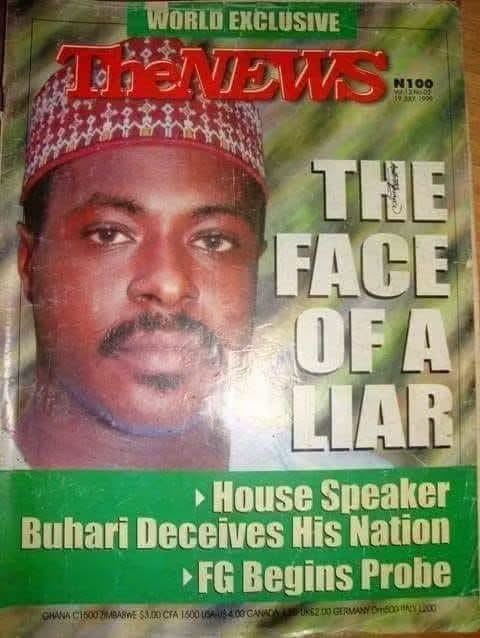
On 16 February 1999, TheNews magazine published an investigative report questioning several details in Buhari’s biography and qualifications.
The timing is important.
The allegations were therefore not first made six weeks after he became Speaker. They were already in the public domain before the June 1999 inauguration of the National Assembly.
The Age Question
One of the most serious issues concerned Buhari’s age.
He had reportedly presented himself as having been born in 1963, which would have made him 36 in 1999.
Investigative reporting by TheNews established that he was actually born in 1970, making him 29 when he contested the House of Representatives election. The National Library of Nigeria records his date of birth as 3 January 1970.
That difference was not merely a question of personal biography.
Under Section 65(1) of the 1999 Constitution, a person had to be at least 30 years old to be qualified for election to the House of Representatives.
If Buhari was indeed 29 at the time of the election, the age discrepancy had direct constitutional consequences for his eligibility.
The University of Toronto Claim
Then came the academic qualification.
Buhari had claimed to have attended and graduated from the University of Toronto.
TheNews contacted the university to verify the claim.
The response became one of the most damaging pieces of evidence in the controversy.
The university said that it could find no record of a person by the name Ibrahim Salisu Buhari in response to the request for confirmation of his degree.
The scandal therefore moved beyond an argument over age.
Questions were now being raised about the authenticity of the educational qualifications that had appeared in his official biography.
Reports also questioned claims concerning an accountancy qualification and his alleged participation in the National Youth Service Corps.
The NYSC Question
Buhari had reportedly claimed that he completed his National Youth Service at Standard Construction in Kano in 1991.
Investigators could not find his name in the relevant NYSC records.
The claim subsequently became another part of the wider controversy surrounding his credentials.
What began as questions about one politician’s biography had therefore become a much larger national debate about the screening of candidates and the ability of political institutions to verify the credentials submitted by aspiring lawmakers.
The Denial
Initially, Buhari rejected the allegations.
He reportedly described the accusations as a form of persecution and threatened legal action against TheNews magazine.
But the controversy continued to grow.
The National Assembly was eventually confronted with a crisis involving the credentials of its presiding officer only weeks after the return to civilian government.
On 23 July 1999, Buhari resigned as Speaker and as a member of the House of Representatives.
He also publicly apologised to Nigerians.
In his resignation statement, he expressed regret for the embarrassment caused by the controversy and asked Nigerians for forgiveness. Contemporary records preserve the statement as his final address to the House before leaving office.
From Speaker to Courtroom
Buhari’s resignation did not end the matter.
After losing the protection associated with his parliamentary office, he was prosecuted.
He was eventually convicted of offences connected with forgery and false declarations.
The National Library of Nigeria records that he was sentenced to two years’ imprisonment with an option of a fine, which he paid.
Academic literature on Nigeria’s criminal justice system has also cited the case as an early example of plea bargaining in the country’s Fourth Republic.
The scandal had therefore moved through three distinct stages:
investigative journalism → political resignation → criminal prosecution.
For a country only weeks into its new democratic experiment, the symbolism was enormous.
The Presidential Pardon
Buhari later received a state pardon from President Olusegun Obasanjo.
The pardon became controversial because it meant that a politician who had been convicted over the very qualifications that had brought down his speakership was eventually able to re-enter aspects of public life.
The pardon is documented by the National Library of Nigeria and academic accounts of the Jonathan presidency.
The 2013 Controversy
Fourteen years after the Toronto scandal, Buhari’s name returned to the national conversation.
In April 2013, President Goodluck Jonathan’s administration appointed him to the Governing Council of the University of Nigeria, Nsukka.
The appointment generated considerable criticism, particularly because the scandal that had destroyed his political career had involved a false claim about university qualifications.
The administration defended the appointment, with presidential spokesman Reuben Abati arguing that membership of a university governing council did not necessarily require the person to be a university graduate.
The appointment consequently revived public debate about whether a previous conviction should permanently prevent someone from holding public responsibilities after receiving a presidential pardon.
Why the Toronto Saga Still Matters
The Salisu Buhari affair became much more than the story of one politician who falsified his credentials.
It exposed weaknesses in the processes through which political candidates’ ages, educational qualifications and NYSC records were verified.
It also demonstrated the power of investigative journalism.
At a time when Nigeria was emerging from military rule, TheNews investigation showed how a newspaper investigation could challenge one of the country’s most powerful newly elected politicians and trigger consequences that formal political institutions had not prevented.
Buhari had risen to the Speakership of the House of Representatives.
Within weeks, questions about his age and certificates had transformed his political career.
By 23 July 1999, he was gone.
The House subsequently elected Ghali Umar Na’Abba as Speaker.
A Scandal That Became a Symbol
The Toronto Saga has remained part of Nigeria’s political memory because it occurred at the very beginning of the Fourth Republic.
It was one of the earliest major scandals to confront the newly restored democratic institutions.
The episode raised questions that Nigeria would continue to confront for years:
Who verifies the credentials of political candidates?
How thoroughly are official records checked before people occupy public office?
What happens when political ambition outruns the truth?
And perhaps most importantly:
Does resignation, conviction and eventual pardon close the chapter, or does public office require a different standard of accountability?
Those questions have remained relevant in subsequent debates over academic credentials and public office in Nigeria.
The Salisu Buhari affair therefore occupies a distinctive place in Fourth Republic history.
He entered the National Assembly as one of the youngest faces of Nigeria’s new democracy.
He became Speaker on 3 June 1999.
Fifty days later, he resigned amid a scandal over his age and qualifications.
He was subsequently prosecuted and convicted.
Years later, he received a presidential pardon and returned to public appointments.
The story began with a young politician who appeared to embody the promise of a new democratic era.
It ended by becoming a cautionary tale about credentials, verification, accountability and the consequences of placing ambition ahead of truth.
That is the story Nigerians came to remember as the Toronto Saga.
Sources
National Library of Nigeria, Portrait of Hon. Ibrahim Salisu Buhari, documenting his birth date, speakership, conviction, sentence, payment of fine and subsequent state pardon.
TheNews, contemporary reporting and later retrospective account of the Buhari certificate scandal.
University of Ibadan Repository, The Jonathan Presidency: The Sophomore Year, documenting Buhari’s 2013 appointment to the University of Nigeria Governing Council and the earlier presidential pardon.
TheNews, retrospective account of certificate-forgery controversies involving Nigerian politicians.
Nigerian Law Forum, Commissioner of Police v. Alhaji Salisu Ibrahim Buhari (2000), concerning the prosecution arising from the 1999 forgery allegations.
African Journal of Political Science and International Relations, study of plea bargaining and anti-corruption efforts in Nigeria, including the Salisu Buhari case.
Photograph: Salisu Buhari on the cover of TheNews magazine during the 1999 certificate and age controversy. Photograph credit: Nigerian History.
Photo credit: Clara Dike Wall — Home of History.