Long before Nigeria’s banking halls became part of everyday life, a financial institution opened its doors in Lagos that would eventually become one of the country’s longest-standing banks.
Today, that institution is known as Union Bank of Nigeria.
But the name on its signboard has changed several times over more than a century.
Its story began in 1917 as Colonial Bank, passed through the era of Barclays Bank DCO, became Barclays Bank of Nigeria, and eventually emerged as Union Bank of Nigeria following the indigenisation of the Nigerian economy.
The beginning: Colonial Bank, 1917
The history of Union Bank can be traced to 1917, when Colonial Bank established its operations in Nigeria.
At the time, banking in Nigeria was still largely dominated by foreign institutions serving the needs of colonial administration and European commercial interests. The establishment of Colonial Bank added another major player to the developing banking sector. Academic research on Nigerian banking history also records Colonial Bank as one of the institutions that entered the Nigerian banking scene in 1917.
Its early Nigerian operations were centred in Lagos, with the institution subsequently expanding its branch network.
1925: The Barclays era begins
Eight years later, another major transformation took place.
In 1925, Colonial Bank was acquired by Barclays Bank. The Nigerian operation consequently became associated with Barclays Bank Dominion, Colonial and Overseas — Barclays Bank DCO.
The name reflected Barclays’ international operations across territories that were then part of the British colonial system. Union Bank’s own historical records confirm the 1925 transition.
Under Barclays, the bank expanded its presence across Nigeria.
By the late 1950s, branches had been established in important commercial centres including Kano, Zaria, Aba and Sapele, demonstrating how far the institution had grown beyond its original Lagos base.
1969: Barclays Bank of Nigeria Limited
Nigeria’s independence in 1960 brought a new era of economic and institutional change.
The Companies Act of 1968 required foreign companies operating in Nigeria to incorporate locally. Consequently, the Nigerian operation of Barclays DCO was incorporated as Barclays Bank of Nigeria Limited (BBNL) in 1969.
This was more than a change in name.
It reflected the wider process through which Nigeria was increasingly seeking greater local participation and control over businesses operating within its economy.
The era of indigenisation
The 1970s brought perhaps the most important ownership transformation in the bank’s history.
In 1971, Barclays Bank of Nigeria was listed on the Nigerian Stock Exchange, and Nigerian investors began acquiring shares in the institution. Union Bank’s historical records state that 8.33 per cent of the bank’s shares were offered to Nigerians that year.
Then came the Nigerian Enterprises Promotion Act of 1972, part of the government’s wider indigenisation policy.
The Federal Government acquired a substantial stake in Barclays Bank of Nigeria, while additional shares were made available to Nigerian investors.
A second phase of indigenisation followed after the 1977 Nigerian Enterprises Promotion Decree.
By 1979, Barclays Bank International had disposed of its remaining significant Nigerian interest, and the bank became wholly Nigerian-owned.
The birth of Union Bank
The transformation in ownership required a new identity.
On 12 March 1979, Barclays Bank of Nigeria changed its name to Union Bank of Nigeria. Union Bank’s own historical publication identifies 1979 as the year in which the institution became Union Bank of Nigeria and entered a new era of indigenous ownership.
The new name symbolised more than corporate rebranding.
It represented a financial institution that had moved from its colonial-era origins into Nigerian ownership during a period when the country was deliberately increasing indigenous participation in major businesses.
From government ownership to privatisation
The story did not end with Nigerian ownership.
For a period, the Federal Government remained a major shareholder. However, the economic reforms of the 1990s brought another major transition.
In 1993, as part of the Federal Government’s privatisation and commercialisation programme, its controlling 51.67 per cent stake was sold to private investors.
Union Bank subsequently became fully owned by Nigerian citizens and private-sector organisations.
The institution therefore passed through several distinct ownership eras:
Colonial Bank → Barclays Bank DCO → Barclays Bank of Nigeria → Nigerian-owned Union Bank → Privatised Union Bank.
Surviving Nigeria’s banking transformations
Over the decades, Union Bank survived some of the most significant changes in Nigeria’s financial history.
It expanded its branch network, introduced new banking services and became an important part of commercial activity across the country.
The bank also survived the banking-sector crisis of the late 2000s. Following intervention by the Central Bank of Nigeria and the Asset Management Corporation of Nigeria (AMCON), Union Bank was recapitalised in 2012, with Union Global Partners Limited acquiring a 65 per cent stake. Atlas Mara later acquired AMCON’s remaining 20 per cent interest in 2014.
The bank subsequently underwent another major ownership change.
In 2022, following regulatory approvals, Titan Trust Bank completed the acquisition of majority control of Union Bank, taking over an aggregate 93.41 per cent of its issued share capital. The process eventually resulted in the delisting of Union Bank’s shares from the Nigerian Stock Exchange in 2023.
More than a bank
The history of Union Bank mirrors several chapters of Nigeria’s economic history.
It began during colonial rule.
It expanded during the final decades of British administration.
It was incorporated locally after independence.
It became part of Nigeria’s indigenisation programme in the 1970s.
It was privatised in the 1990s.
It survived the banking crisis of the 2000s.
And it eventually entered another ownership era under Titan Trust Bank.
From Colonial Bank in 1917 to the Union Bank associated with modern Nigerian banking, the institution’s story spans more than a century of political, economic and corporate transformation.
The name changed.
The ownership changed.
The banking technology changed.
But the institution remained part of Nigeria’s financial story.
From Colonial Bank to Barclays Bank DCO, from Barclays Bank of Nigeria to Union Bank — more than a century of banking history lives behind the name.
Sources
– Union Bank of Nigeria, “Our History” — official corporate history covering the bank’s origins in 1917, Barclays era, indigenisation, privatisation and later ownership changes.
– Union Bank, 2017 Citizenship, Sustainability & Innovation Report — historical timeline documenting the 1968 renaming, 1971 listing, 1970s Nigerian ownership and 1979 adoption of the Union Bank name.
– Securities and Exchange Commission Nigeria, Union Bank Rights Circular — corporate historical record of the bank’s establishment, Barclays period and Nigerianisation between 1971 and 1979.
– Cambridge University Press, “The Bank Customer and Banking Law in Nigeria” — academic history placing Colonial Bank’s establishment in 1917 and its transition into Barclays Bank DCO in 1925.
– University of Ibadan Repository — historical research documenting the development of the Nigerian Standard and other aspects of Nigeria’s banking and economic history.
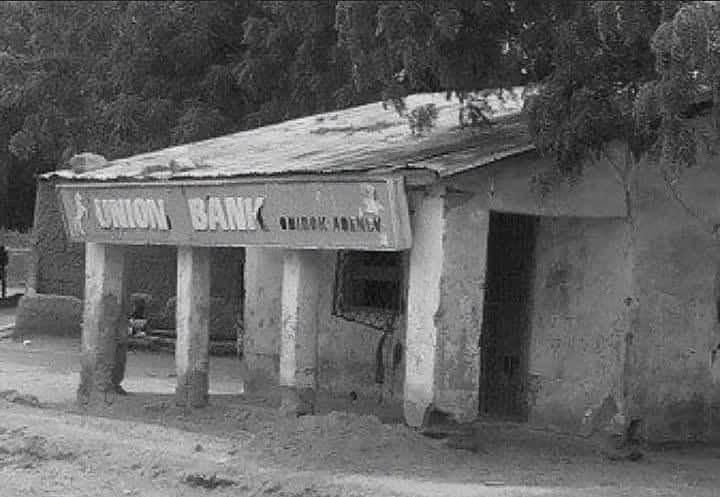
Photograph caption: An archival photograph of Union Bank, one of Nigeria’s oldest banking institutions. Photo credit: Nigerian Museum.