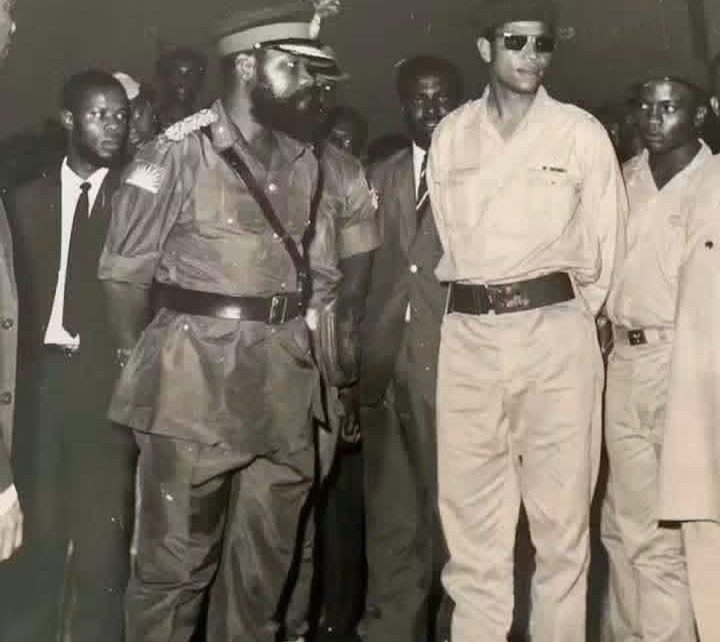
Standing beside Chukwuemeka Odumegwu-Ojukwu in this photograph is Lieutenant-Colonel Louis Austin Chude-Sokei, a Sandhurst-trained military officer who became one of the leading figures in Biafra’s attempt to establish an air force during the Nigerian Civil War.
His wartime story involved a hijacked passenger aircraft, improvised military aviation, a desperate struggle for survival and a family caught in the humanitarian catastrophe that engulfed Biafra.
In March 1968, Chude-Sokei was killed during the fighting around Onitsha. He left behind a young son and a wife whose nursing work during the conflict formed another remarkable part of the family’s history.
From military training to the Biafran struggle
Chude-Sokei received military training at the Royal Military Academy Sandhurst in Britain, an institution that trained officers from several Commonwealth countries. He belonged to a generation of Nigerian military officers whose careers unfolded during the turbulent years surrounding independence and the collapse of the First Republic.
Following the January 1966 coup and the subsequent political crisis, Nigeria moved towards a period of military confrontation. In May 1967, the Eastern Region, under Lieutenant-Colonel Odumegwu-Ojukwu, declared the independent Republic of Biafra. The Federal Military Government rejected the secession, and full-scale war began in July.
When the conflict started, Biafra faced a serious military disadvantage in aviation. The Nigerian Federal Government had access to greater resources, while the emerging Biafran administration had to find ways to acquire aircraft, weapons and trained personnel under increasingly difficult conditions.
Chude-Sokei would become central to that effort.
The hijacking of a Nigeria Airways aircraft
One of the most extraordinary episodes associated with Chude-Sokei was the operation that brought Biafra its first major aircraft acquisition.
On 23 April 1967, before Biafra formally declared independence, a Nigeria Airways Fokker F27 passenger aircraft was hijacked while travelling from Benin to Lagos and diverted to Enugu.
Historical accounts identify Chude-Sokei as the officer who headed the task force involved in planning the operation. The group included military intelligence personnel and individuals with aviation experience, including Nigerian Airways pilots.
The aircraft, registered as 5N-AAV, became available to the Eastern Region authorities and was subsequently repurposed for Biafran military use. Accounts of the emerging Biafran air force describe the aircraft as a makeshift bomber.
The operation illustrates the extraordinary measures taken to obtain aviation assets during the crisis. An aircraft designed for civilian passenger transport became part of a military effort, while the people involved in its acquisition found themselves drawn into a conflict that would last nearly three years.
The Fokker F27 did not survive the war. Historical accounts report that it was shot down by Nigerian anti-aircraft fire on 7 October 1967.
Building an air force with limited resources
After the outbreak of war, Chude-Sokei became a leading commander in the Biafran Air Force. His responsibilities involved more than the acquisition of a single aircraft. Biafra needed pilots, maintenance personnel, operational bases, fuel, spare parts and aircraft that could be adapted to military purposes.
Its early inventory included a mixture of aircraft, among them North American B-25 Mitchells, B-26 Invaders, a converted Douglas DC-3 and a Riley Dove. These aircraft differed in capability and were acquired through a combination of requisition, covert procurement and assistance from foreign supporters.
Biafra’s aviation effort evolved throughout the war. In later years, foreign pilots and supporters helped the Biafran side acquire and operate additional aircraft. The Swedish pilot Carl Gustaf von Rosen became associated with the introduction of the small MFI-9 aircraft known as the “Biafra Babies” in 1969.
That later programme developed after Chude-Sokei’s death and should not be confused with the initial air force he helped organise.
The Biafran air force was small compared with the Federal Nigerian air arm, but its existence reflected the secessionist government’s determination to acquire military capabilities despite shortages and a blockade.
Chude-Sokei’s role in this effort made him an important figure in the military history of the conflict.
Shirley Chude-Sokei: The nurse on the humanitarian front
While Chude-Sokei was involved in Biafra’s military operations, his wife, Shirley Patricia Chude-Sokei, was working as a nurse.
Shirley was born in Jamaica and had trained and worked in Britain before her life became connected with Nigeria and the Biafran conflict. She helped care for wounded people and children affected by the war, which became notorious for its food shortages, displacement and widespread malnutrition.
In an interview with Boston University, their son, Louis Chude-Sokei, described his mother’s work in hospitals and her involvement in caring for wounded people and organising help for starving children.
Her experience reflected the enormous humanitarian burden of the conflict. As fighting disrupted transport routes and food supplies, medical personnel and relief workers struggled to provide treatment and nourishment to civilians, including large numbers of children.
The story of the Chude-Sokei family therefore extends beyond military history. It also connects the Biafran struggle to the international networks of nurses, relief workers and volunteers who responded to the suffering caused by the war.
Death at the Onitsha front
In March 1968, the fighting around Onitsha intensified as Federal Nigerian troops sought to secure the city and advance against Biafran positions.
Chude-Sokei was killed during the fighting. Accounts by former military personnel and later historical discussions describe his death as the result of mortar fire around the Onitsha front, with some accounts placing the incident near Ogidi.
This differs from another version circulating online that attributes his death to a car accident while travelling towards the front. The available military-history accounts more strongly support the mortar-fire explanation.
His death deprived Biafra of a senior officer who had helped develop its air force during the early stages of the conflict.
The war continued for nearly two more years. Biafra surrendered in January 1970, bringing the secessionist state to an end.
The family he left behind
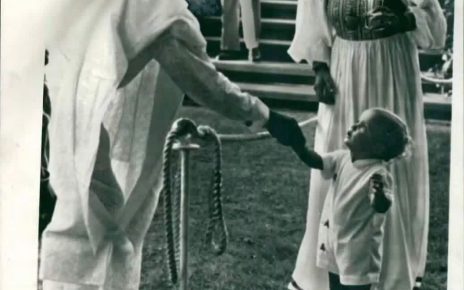
Chude-Sokei’s son was not yet two years old when his father died. The family’s subsequent journey became part of the wider displacement and upheaval caused by the war.
In his memoir, Floating in a Most Peculiar Way, Louis Chude-Sokei recounts growing up amid the consequences of his father’s death and his mother’s efforts to navigate life after Biafra. The family’s story took them through Gabon and Jamaica before Louis eventually settled in the United States.
The memoir offers a personal perspective on a conflict often told through military campaigns, political leaders and territorial changes. It shows how the consequences of war continued for families long after individual battles ended.
Remembering a lesser-known military figure
Lieutenant-Colonel Louis Austin Chude-Sokei occupies a distinctive place in the history of the Nigerian Civil War. He was a professionally trained officer who became involved in the creation of a military air service under extraordinarily difficult conditions.
His name is associated with the hijacking of the Nigeria Airways Fokker F27, the early organisation of Biafra’s air force and the fighting around Onitsha in which he lost his life.
His wife’s humanitarian work and his son’s later memoir add a family dimension to this history, connecting military events with the suffering, displacement and survival experienced by those caught in the conflict.
The photograph of Chude-Sokei standing alongside Ojukwu recalls a brief and turbulent chapter in Nigeria’s past. Behind the uniforms and military titles were people whose lives were shaped, and sometimes cut short, by a war that left deep scars across the country.
Photo credit: Clara Dike
Sources
1. August Okpe, The Last Flight, a historical account of the Biafran Air Force and its pilots, aircraft and operations.
2. Vanguard, “Biafra consumed three service chiefs,” June 2019.
3. Boston University, “Louis Chude-Sokei Writes of Navigating ‘Multiple Blacknesses’,” 13 April 2021.
4. Adom Getachew, The New York Review of Books, “Black Atlantics,” 20 June 2024.
5. The Biafra Memorial, “Soldiers of Fortune: Mercenary Wars,” historical overview of aircraft used during the Nigerian Civil War.