By Prince Uwalaka Chimaroke
7- OCT- 2026
A Chief Magistrates’ Court sitting as a coroner in Owerri, Imo State, has recommended the prosecution of two senior police officers over circumstances surrounding the death of 32-year-old Japhet Njoku, who died while in custody of the Anti-Kidnapping Unit, popularly known as Tiger Base, in May 2025.
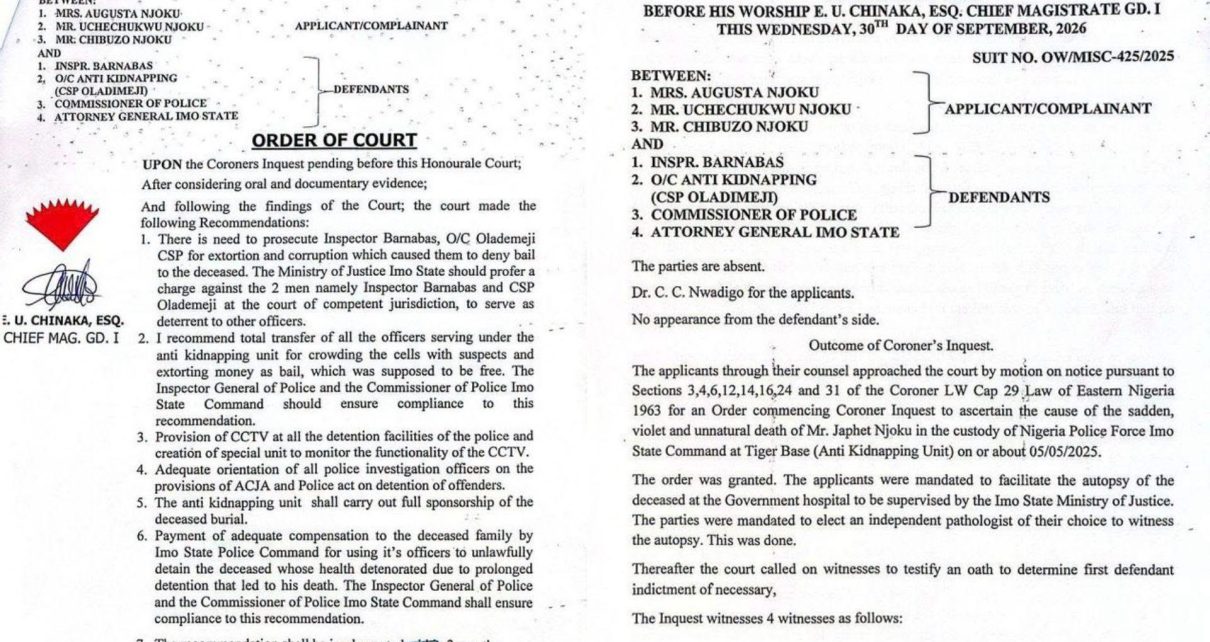
The coroner, presided over by Chief Magistrate E. U. Chinaka, directed the Imo State Ministry of Justice to initiate criminal proceedings against Inspector Barnabas and the Officer-in-Charge of the Anti-Kidnapping Unit, CSP Olademeji, over allegations of extortion and corruption which the court found were connected to Njoku’s prolonged detention.
The inquest followed a petition by members of Njoku’s family seeking clarification on what they described as his sudden, violent and unnatural death while under the custody of the Imo State Police Command.
Evidence before the court indicated that Njoku was arrested on March 29, 2025, following an allegation of stealing goods at Alaba Market. Rather than being promptly charged before a court or released on bail, he reportedly remained in detention for approximately six weeks before his death.
A major issue identified by the coroner was the alleged demand for money as a condition for securing his release. The court found that Inspector Barnabas allegedly demanded N500,000 for police bail, while a further N300,000 was allegedly requested for the complainant, Ugomore Oluchi Obiagwu.
The court consequently concluded that the financial demands allegedly made in connection with bail contributed significantly to Njoku’s prolonged detention, noting that the stealing allegation against him was a bailable offence.
According to the findings, the continued detention went beyond the permissible period for holding a suspect while investigations were ongoing. The court maintained that the circumstances amounted to a serious violation of the rights of a detainee.
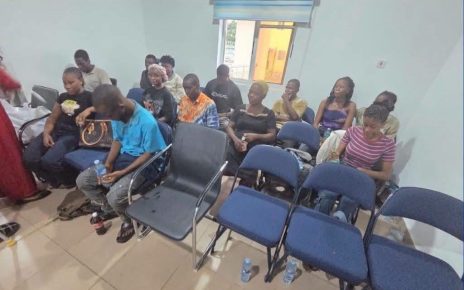
Testimony from Njoku’s brother, Uchechukwu Njoku, further painted a troubling picture of the conditions in which the deceased was allegedly held. He told the court that the family was denied access to Njoku for an extended period and that the deceased had complained about the deplorable state of the detention cell.
Among the conditions reportedly described were an offensive-smelling toilet, severe overcrowding and circumstances that allegedly forced detainees to remain standing for long periods. Uchechukwu also testified that his brother had developed a wound on the left side of his head and, to the family’s knowledge, had no previous illness before his arrest.
Inspector Barnabas, while appearing before the inquest, acknowledged that Njoku spent about six weeks in detention. He, however, attempted to justify the continued detention by claiming that the deceased had allegedly been identified by CSP Olademeji as a terrorist during a routine cell inspection.
Barnabas further claimed that Njoku had confessed to being a terrorist. The coroner, however, found that the alleged confession was neither produced before the court nor shown to have been properly recorded in accordance with Section 18(2) of the Administration of Criminal Justice Act.
The officer also denied demanding money for Njoku’s release, maintaining that police bail was free. The explanation did not persuade the court, which rejected the terrorism narrative and described it as a fabrication allegedly designed to conceal an unlawful practice of prolonged detention, extortion and corruption.
The inquest also heard evidence from Basil Ekenyere, who described the detention facility as grossly overcrowded. He reportedly told the court that more than 45 suspects were held in a space he estimated at only about three or four ceiling lengths.
Ekenyere further alleged that the conditions inside the facility were so severe that detainees sometimes died. He also testified from his own experience that he paid N300,000 to settle the complainant and another N650,000 as police bail before securing his release.
In its findings, the coroner expressed serious concern over the alleged treatment of suspects at the Anti-Kidnapping Unit, accusing officers of abandoning their professional responsibilities and resorting to practices involving torture, intimidation and extortion.
The court also linked the overcrowding of the facility to the alleged refusal to release suspects who were unable to meet financial demands for bail. It stressed that such practices undermined constitutional guarantees concerning human dignity, personal liberty, access to legal representation, the right to life and the right to bail.
On the circumstances of Njoku’s death, the coroner found that the prolonged detention and alleged inhumane conditions contributed to the deterioration of his health. The court concluded that the extended detention played a significant role in the chain of events that culminated in his death.
An autopsy report presented during the proceedings identified meningitis, bronchial pneumonia and hypertensive heart disease as the causes of death. However, the medical pathologist responsible for the report did not appear before the inquest to give evidence.
Beyond recommending prosecution, the coroner proposed a series of institutional reforms aimed at preventing similar incidents within police detention facilities.
The Imo State Ministry of Justice was directed to prosecute Inspector Barnabas and CSP Olademeji for alleged extortion and corruption. The court said the prosecution should serve as a deterrent to other officers who might abuse their powers or exploit detainees.
The coroner further recommended the immediate transfer of officers serving in the Anti-Kidnapping Unit, citing the allegations of overcrowding and the collection of money in connection with police bail.
The Inspector-General of Police and the Commissioner of Police, Imo State Command, were directed to ensure that the recommendations are implemented.
Among the other recommendations was the installation of functional closed-circuit television cameras in police detention facilities, alongside the establishment of a dedicated mechanism for monitoring their operation.
The court also called for comprehensive training and orientation of police investigators on the provisions of the Administration of Criminal Justice Act and the Police Act, particularly as they relate to the lawful detention and treatment of suspects.
In a further directive, the coroner ordered the Anti-Kidnapping Unit to bear the cost of Njoku’s burial and recommended adequate compensation for his family over what the court described as his unlawful detention and the deterioration of his health while in custody.
The Inspector-General of Police and the Imo State Commissioner of Police were again directed to ensure compliance with the compensation order.
The authorities were given a three-month period within which to implement the recommendations.
The ruling has therefore placed renewed attention on the treatment of suspects in police custody, the administration of bail and the need for stronger institutional safeguards against alleged abuse of detention powers.
Beyond the individual circumstances surrounding Njoku’s death, the recommendations underscore the responsibility of law-enforcement institutions to uphold due process and protect the dignity and fundamental rights of persons held in custody.
The case also highlights the importance of effective oversight, transparent detention procedures and accountability mechanisms capable of detecting and addressing abuses before they result in irreversible consequences.