
Columns
Dr. Abubakar Olusola Saraki: The Beginnings of a Political Dynasty

On 17 May 1933, Abubakar Olusola Saraki was born in Ilorin, in present-day Kwara State, Nigeria. Though he would later become one of the most influential political figures in Northern Nigeria, his first foray into politics was marked by defeat rather than triumph.
The 1964 Federal Election: A First Attempt
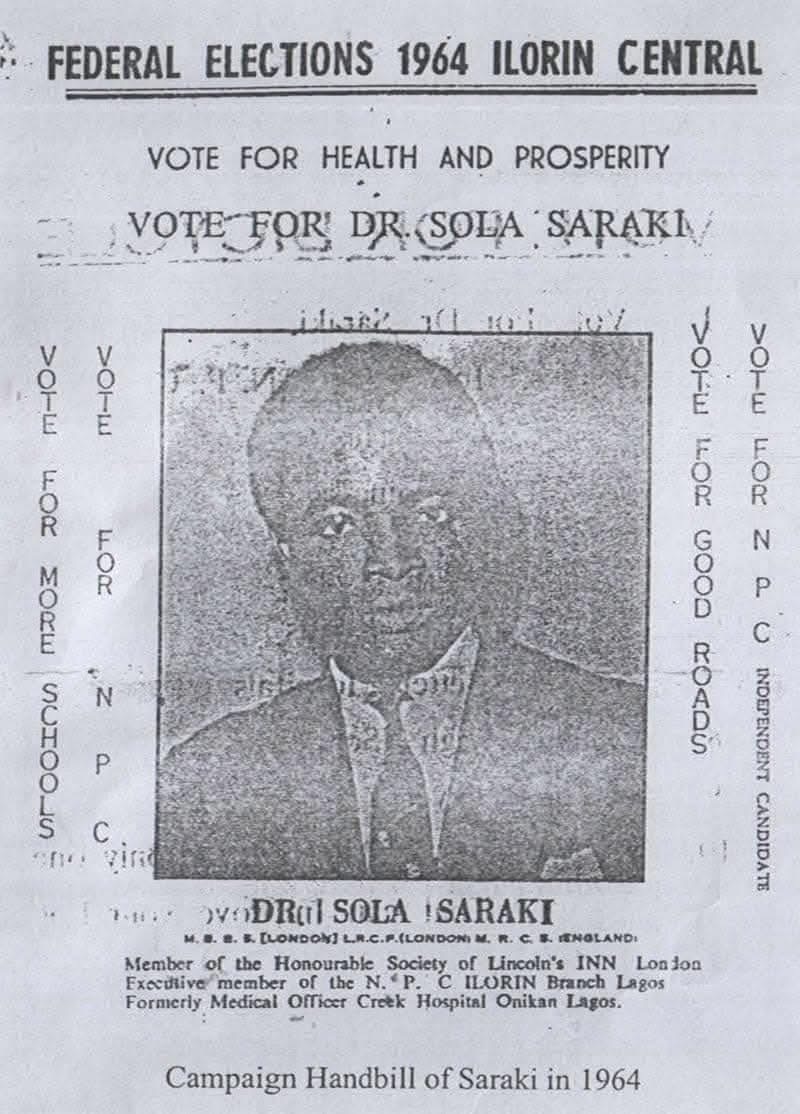
A campaign handbill from the 1964 Nigerian federal elections captures the earliest chapter of Saraki’s political journey. In that election, Dr. Saraki contested for the Ilorin Central constituency seat as an independent candidate aligned with the Northern People’s Congress (NPC), the dominant political party in Northern Nigeria at the time.
Despite his professional reputation as a London-trained medical doctor and a respected figure within the Ilorin community, Saraki was unsuccessful in securing the parliamentary seat. The 1964 elections themselves were fraught with controversy, marred by political tension, boycotts, and widespread allegations of irregularities, reflecting the instability of Nigeria’s First Republic.
Following this electoral setback, Saraki withdrew from active politics and returned to his thriving medical practice in Lagos.
Return to Politics: The Second Republic
Dr. Saraki remained largely outside partisan politics until 1978/79, when Nigeria began its transition from military rule to civilian governance, ushering in the Second Republic. During this period, he joined the National Party of Nigeria (NPN) and successfully won election as a Senator representing Kwara State in 1979.
His political influence grew significantly during the Second Republic (1979–1983), where he emerged as a key power broker in Kwara State politics. Over time, Saraki became widely regarded as the architect of Kwara’s political structure, earning a reputation as a formidable strategist and kingmaker.
Traditional Title and Influence
Beyond elective office, Saraki held the prestigious traditional title of Waziri of the Ilorin Emirate, further cementing his status within both political and traditional institutions. His influence extended across decades, shaping the political direction of Kwara State well beyond his time in office.
Legacy
Although his first political outing in 1964 ended in defeat, that campaign marked the beginning of a long and consequential career. Dr. Olusola Saraki’s trajectory—from an unsuccessful independent candidate to a dominant political figure—illustrates the evolving nature of Nigerian politics from the First Republic through the Second Republic and beyond.
He remains a central figure in discussions of Kwara State’s political history and the foundations of one of Nigeria’s most enduring political families.
Sources
Northern People’s Congress historical records on First Republic elections.
National Party of Nigeria party archives and Second Republic election results (1979).
Profiles and biographical records of Abubakar Olusola Saraki in Nigerian political history publications.
Nigerian Federal Election reports, 1964.





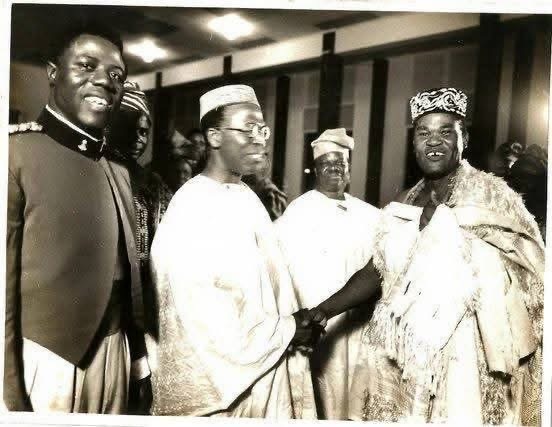
In 1964, Western Nigeria was engulfed in intense political crisis. Chief Obafemi Awolowo, leader of the opposition and a dominant political figure in the Western Region, had been convicted on charges of treasonable felony in 1963 and was serving a prison sentence. His incarceration deepened political divisions within the region.
It was in this atmosphere that legendary dramatist Hubert Ogunde intervened — not with weapons or speeches, but with theatre.
Yoruba Ronu (“Yoruba, Think!”)
In 1964, Ogunde staged the controversial play Yoruba Ronu. The drama was widely interpreted as a sharp critique of the political leadership of the Western Region, particularly targeting Samuel Ladoke Akintola, who was then Premier.
The play addressed themes of betrayal, factionalism, and the dangers of political disunity among the Yoruba. Its message resonated deeply at a time when the region was polarized between Awolowo’s supporters and Akintola’s government.
The response was swift. The government banned Ogunde’s theatre company from performing in the Western Region for two years (1964–1966). Given that the majority of his audience was Yoruba-speaking and based in that region, the ban had severe financial consequences.
Otito Koro (“Truth Is Bitter”)
In reaction to the ban, Ogunde produced another politically charged play, Otito Koro. The title itself suggested defiance. Through allegory and symbolism, Ogunde continued to challenge political authority and defend artistic expression.
His theatre became a forum for political reflection — a rare platform in an era when dissent was increasingly suppressed.
The 1966 Coup and Aftermath
On January 15, 1966, Nigeria experienced its first military coup. Premier Samuel Ladoke Akintola was killed during the coup, and the Western Region government was overthrown. The military takeover dramatically altered Nigeria’s political landscape.
Shortly afterward, the ban on Ogunde’s theatre company was lifted by Francis Adekunle Fajuyi, who had been appointed Military Governor of the Western Region.
Many observers later described Yoruba Ronu as prophetic — a cultural warning about the destructive consequences of political division.
Theatre as Political Resistance
The encounter between Ogunde’s art and Awolowo’s political struggle illustrates a broader truth about Nigerian history: theatre was not merely entertainment. It was activism.
Hubert Ogunde used performance to:
Critique political leadership
Mobilize public consciousness
Preserve Yoruba cultural identity
Challenge censorship
In doing so, he demonstrated that the stage could be as powerful as the parliament.
Historical Significance
The events surrounding Yoruba Ronu highlight:
The deep crisis within the Western Region during the First Republic
The intersection of culture and politics in post-independence Nigeria
The risks faced by artists who challenged authority
Today, Ogunde is remembered not only as a pioneer of Nigerian theatre but also as one of its boldest political voices — a dramatist who dared to tell the truth in turbulent times.
Sources
Ebun Clark, Hubert Ogunde: The Making of Nigerian Theatre (Oxford University Press).
Biodun Jeyifo, The Yoruba Popular Travelling Theatre of Nigeria.
Tekena N. Tamuno, Nigeria Since Independence: The First 25 Years.
Toyin Falola & Matthew Heaton, A History of Nigeria.
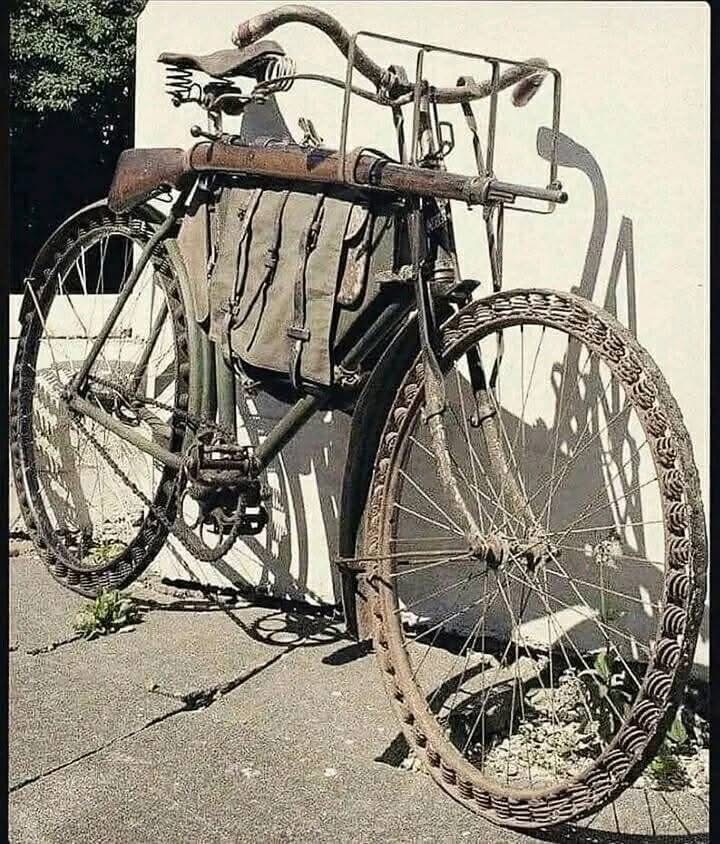
The image shows a German military bicycle from the early 20th century, identified as a Herrenrad Victoria model used during World War I.
Spring Wheel Innovation
Instead of standard rubber tires, the bicycle features metal spring wheels.
The spring system functioned as a shock absorber, helping riders travel across rough terrain such as mud, gravel, and battlefield tracks.
These wheels were developed due to a severe rubber shortage in Germany during the war.
Military Adaptations
Equipped with a mounted rifle holder, carrying a Mauser rifle (standard German service rifle of the era).
Includes canvas pouches attached to the frame for:
Ammunition
Dispatch documents
Essential field supplies
These modifications transformed the bicycle into a compact, mobile military tool.
Historical Importance
Military bicycles played a crucial role in logistics, reconnaissance, and message delivery.
They provided silent movement, unlike motor vehicles.
More reliable than horses in certain terrains and required no fuel.
Particularly useful in areas where trucks and armored vehicles could not operate effectively.
Broader Context
During World War I, many European armies—including Germany, France, and Britain—experimented with bicycle infantry units. These units combined speed, efficiency, and low maintenance costs, making bicycles an important yet often overlooked part of early 20th-century military strategy.
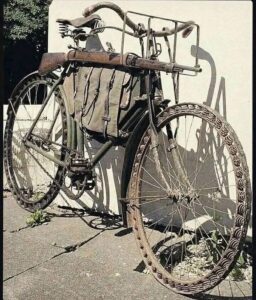
Spring Wheel Bicycle
Columns
On 5 March 1986, three of Nigeria’s most celebrated literary figures — John Pepper Clark, Chinua Achebe, and Wole Soyinka — arrived at Dodan Barracks in Lagos.
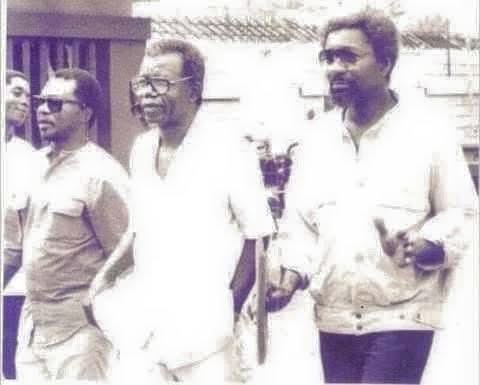
They went to appeal directly to Nigeria’s Head of State, Ibrahim Babangida, seeking clemency for their friend and colleague, Mamman Vatsa, a Major-General in the Nigerian Army.
Vatsa, who was also a poet and a long-time associate of Babangida, had been accused of involvement in a coup plot against the military government. Despite the intervention of the three writers — representing the moral voice of Nigeria’s intellectual community — the appeal was unsuccessful.
Major-General Mamman Vatsa was executed later that same day, marking one of the most controversial episodes of Nigeria’s military era. The event highlighted the limits of intellectual influence under military rule and remains a powerful symbol of the tension between power, friendship, and conscience in Nigeria’s history.
Source: History Ville

El-Rufai sues ICPC over validity of search warrant

Dr. Abubakar Olusola Saraki: The Beginnings of a Political Dynasty

Fake Air Force officer arrested over three-year fraud scheme in Lagos

-
Business1 year ago
US court acquits Air Peace boss, slams Mayfield $4000 fine
-

 Trending1 year ago
NYA demands release of ‘abducted’ Imo chairman, preaches good governance
-

 Politics1 year ago
Mexico’s new president causes concern just weeks before the US elections
-

 Politics1 year ago
Putin invites 20 world leaders
-

 Politics1 year ago
Russia bans imports of agro-products from Kazakhstan after refusal to join BRICS
-
Entertainment1 year ago
Bobrisky falls ill in police custody, rushed to hospital
-
Entertainment1 year ago
Bobrisky transferred from Immigration to FCID, spends night behind bars
-
Education1 year ago
GOVERNOR FUBARA APPOINTS COUNCIL MEMBERS FOR KEN SARO-WIWA POLYTECHNIC BORI